

Reishi: The Complete, Evidence-Based Guide
Reishi Mushroom: The Complete, Evidence-Based Guide
Reishi shows up everywhere in this category — sleep blends, stress blends, skin blends, "calm" anything. Most of that attention is earned. Some of it is marketing getting ahead of the evidence. Here's the actual picture: what reishi is, what it does, how much to take, and where the real cautions are.
What Reishi Actually Is
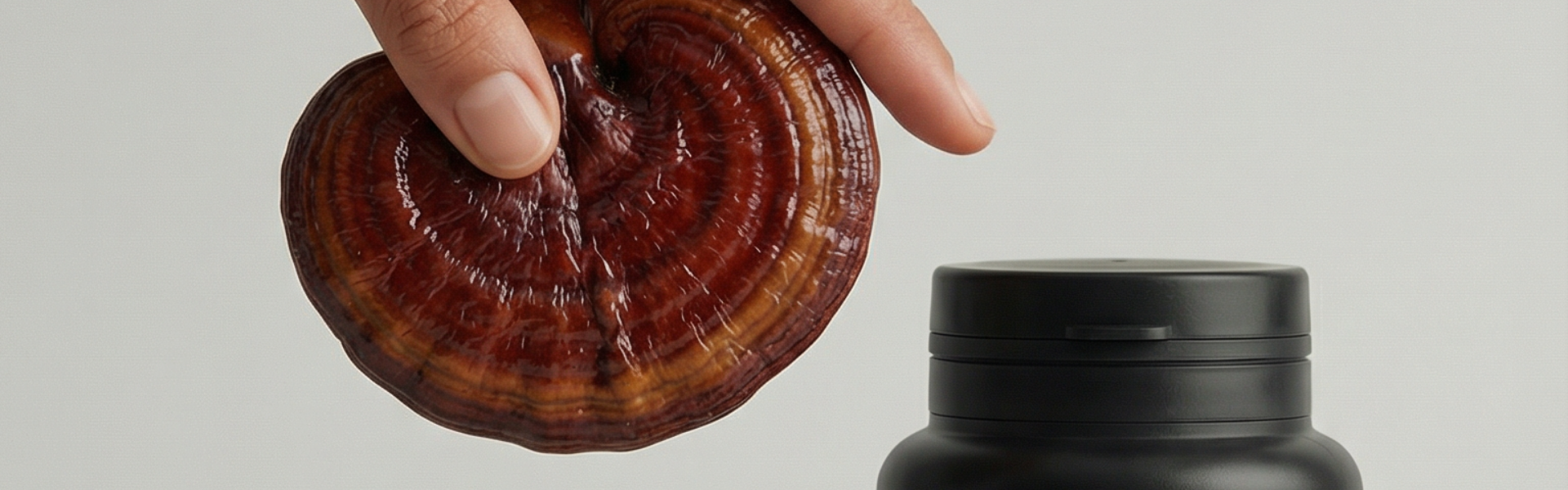
Reishi (Ganoderma lucidum) is a hard, woody mushroom with a centuries-long history of traditional use across East Asian medicine, prized particularly for calm and longevity. Its most-studied compounds are triterpenes — specifically ganoderic acids — and polysaccharide beta-glucans. The two require different extraction methods to access: beta-glucans are water-soluble, ganoderic acids are not, which is why a water-only extract misses a meaningful fraction of what reishi is actually known for [1].
What the Research Actually Supports
Animal research has found that Ganoderma lucidum extract increased total sleep time and improved sleep quality in mice, with a serotonin-involved pathway proposed as one mechanism [2]. This is genuinely interesting, mechanistically specific research — and it's mouse research, not a human clinical trial. The honest position: promising lead, not proven outcome in humans yet, which sits alongside (not instead of) reishi's long traditional use for exactly this purpose.
Separately, an independent quality-consistency analysis of reishi supplements sold in the US found that only about 26% of tested batches actually matched their label claims [3] — which has nothing to do with whether reishi "works" and everything to do with whether the bottle in front of you contains what it says. Worth knowing before any of the rest of this matters.
Dosage
Reference sources for herbal dosing report reishi mushroom used in doses ranging from roughly 1,400–5,400mg daily by mouth in divided doses for whole powder, while the Chinese Pharmacopoeia recommends 6–12g daily of extract; clinical trials using concentrated polysaccharide extracts (Ganopoly) have used up to 5.4g daily for 12 weeks [4][5]. There's no single universally agreed "correct" dose — it depends heavily on whether you're using whole powder, a water extract, or a dual extract, since concentration varies enormously between forms.
Side Effects and Who Should Be Cautious
Reported side effects are generally mild: dizziness, dry mouth, itching, nausea, and stomach upset are the most commonly noted [4]. The more important caution is specific, not vague: reishi has documented anticoagulant (blood-thinning) properties and may enhance the effects of blood thinners, antiplatelet medications, and NSAIDs — this is consistently flagged across pharmacology references, not a fringe concern [4][5][6]. If you're on warfarin, aspirin therapy, or any anticoagulant, talk to your doctor before adding reishi, full stop. There are also documented interactions with blood pressure medication and immunosuppressants [6]. Safety data in pregnancy and breastfeeding is insufficient, so caution is warranted there too [4].
Reishi for Anxiety and Stress
This is where the evidence gets traditional-use-heavy and clinical-trial-light. The triterpene content is the proposed mechanism for stress-response effects, and reishi's centuries of traditional use for calm is real cultural and clinical-practice evidence in its own right — but large, rigorous human trials specifically isolating reishi's effect on anxiety are limited. We'd rather say that plainly than imply more certainty than exists.
Timeline
Reishi is consistently the slowest-acting mushroom in this category to show effects. Most people report meaningful change at 6–8 weeks of consistent use — this lines up with the duration used in most of the clinical research, not a coincidence.
How Gribb Approaches Reishi
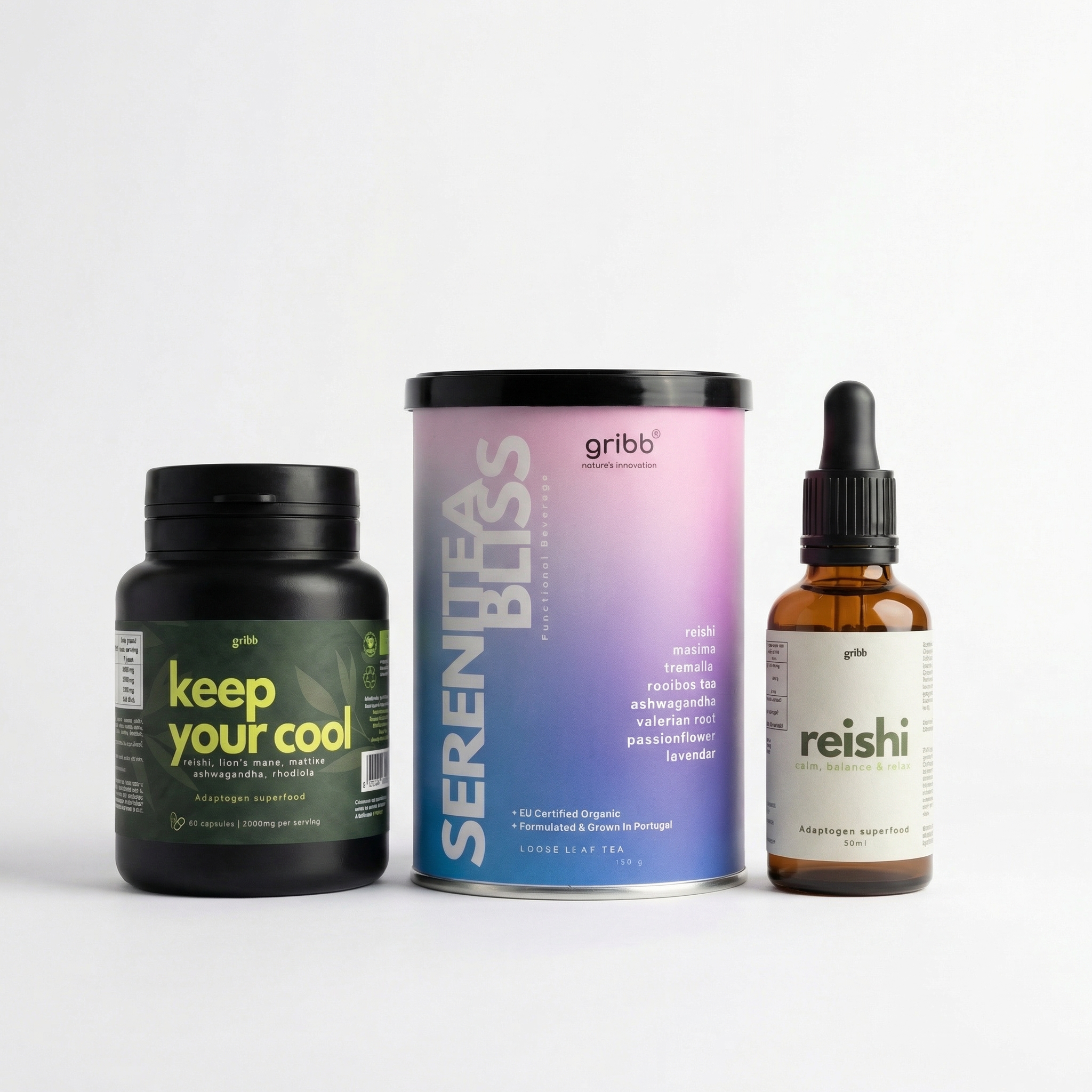
Our reishi is grown as fruiting body — not mycelium on grain — on our farm in Portimão, Portugal, on wood-based substrate sourced locally from Monchique, and dual-extracted (water and alcohol) at a 10:1 ratio specifically so the ganoderic acid fraction isn't lost the way it is in water-only extracts. For more on how to evaluate any mushroom supplement's quality, see How to Actually Tell If a Functional Mushroom Supplement Works. If sleep is the symptom bringing you here, see Why You're Exhausted But Can't Sleep for the fuller nervous-system mechanism.
FAQ
What does reishi mushroom actually do? Its main studied compounds are ganoderic acid triterpenes and beta-glucan polysaccharides, associated with traditional use for calm and stress resilience, and with promising (currently animal-level) research into sleep quality.
Is reishi safe to take long-term? Reishi extract is generally considered possibly safe for up to a year of use, and whole powder for up to 16 weeks, based on available safety data — but anyone on blood thinners, blood pressure medication, or immunosuppressants should talk to a doctor first.
Does reishi interact with medication? Yes — most notably with anticoagulants, antiplatelet drugs, and NSAIDs, due to reishi's own blood-thinning properties. It also has documented interactions with blood pressure medication and immunosuppressants.
What's the best time of day to take reishi? There's no strong evidence pointing to one specific time; most people take it in the evening given its traditional association with calm and sleep, but this is a practical convention rather than a clinically established requirement.
How is reishi different from other adaptogens? Reishi is most specifically associated with calm, sleep, and stress resilience, distinguishing it from cognition-focused mushrooms like lion's mane or energy-focused ones like cordyceps.
Is reishi safe during perimenopause? There's no specific contraindication, but as with any supplement during this period, it's worth discussing with a doctor or gynaecologist, especially alongside any other medication.
This article is for informational purposes only and is not a substitute for medical advice. Gribb's products are not intended to diagnose, treat, cure, or prevent any disease.
References
- Recent Advances in the Preparation, Structure, and Biological Activities of β-Glucan from Ganoderma Species: A Review. PMC. https://www.ncbi.nlm.nih.gov/pmc/articles/PMC10419088/
- Ganoderma Lucidum Promotes Sleep Through a Gut Microbiota-Dependent and Serotonin-Involved Pathway in Mice. Scientific Reports. https://www.nature.com/articles/s41598-021-92913-6
- Evaluation on Quality Consistency of Ganoderma Lucidum Dietary Supplements Collected in the United States. PMC. https://www.ncbi.nlm.nih.gov/pmc/articles/PMC5552695/
- Reishi Mushroom: Overview, Uses, Side Effects, Precautions, Interactions, Dosing. WebMD. https://www.webmd.com/vitamins/ai/ingredientmono-905/reishi-mushroom
- Reishi Mushroom — Natural Products Database. Drugs.com. https://www.drugs.com/npp/reishi-mushroom.html
- Reishi Mushroom: Drug Interactions. Medscape. https://reference.medscape.com/drug/ganoderma-lucidum-ling-chih-reishi-344488
Read more
Matched to Your Symptoms: Which Functional Mushroom Does What in Perimenopause
You don't need to guess. Brain fog, sleep that won't come, skin that's lost its bounce, a metabolism that suddenly feels unfamiliar — each has a mechanism, and each mechanism has a mushroom that wa...
Read more
Mushcoffee: Why Four Mushrooms Beat One (And Half the Caffeine Changes Everything)
Instant coffee has a reputation problem. Mushcoffee is here to fix it. In short: Gribb's Mushcoffee is a functional coffee product combining organic Arabica (50%) with 2,000mg of whole-fruiting-bod...
Read more