

Matched to Your Symptoms: Which Functional Mushroom Does What in Perimenopause
You don't need to guess. Brain fog, sleep that won't come, skin that's lost its bounce, a metabolism that suddenly feels unfamiliar — each has a mechanism, and each mechanism has a mushroom that was studied for exactly that. Here's the map nobody gave you.
Nobody sits you down during perimenopause and explains what's actually happening. You get told it's "just hormones," handed a leaflet about hot flushes, and sent on your way — while your brain fog, your sleep, your skin, and your blood sugar all shift in ways that feel disconnected from each other but aren't.
They're not random. Oestrogen receptors exist throughout the brain, skin, gut, and metabolic tissue — which is precisely why its decline during perimenopause produces symptoms that look unrelated but share a common hormonal root [1]. Several functional mushroom compounds have been studied for the specific physiological pathways involved in some of these symptoms — though, as you'll see below, the strength of that evidence varies considerably by symptom, and we've been specific about that rather than smoothing it over. This is not a "take this for general wellness" article. It's a symptom-to-mechanism map, with the evidence graded honestly.
How to use this guide
Find your most pressing symptom below. Read the mechanism. Then look at which Gribb mushroom is associated with that pathway. You can take more than one — most of our customers build a small stack rather than relying on a single species.
Brain fog and forgetting why you walked into the room → Lion's Mane
Symptom: Brain fog, word-finding difficulty, short-term memory lapses
Lion's Mane — Hericium erinaceus
Oestrogen receptors are dense throughout the hippocampus and prefrontal cortex — the regions responsible for memory consolidation and executive function. As oestrogen fluctuates and declines during perimenopause, these regions lose a layer of support they relied on for decades [1]. This is not a metaphor for confusion; it's a measurable shift in neuronal signalling.
Lion's Mane contains hericenones (concentrated in the fruiting body) and erinacines, compounds studied for their role in stimulating Nerve Growth Factor (NGF) synthesis — a protein involved in the maintenance and survival of neurons, particularly in the hippocampus [2]. Two separate double-blind, placebo-controlled trials have tested this directly: a 2009 trial found that adults aged 50–80 with mild cognitive impairment taking 3g/day of Lion's Mane powder for 16 weeks showed significant improvement on a validated cognitive scale compared to placebo, with effects reversing after a washout period — suggesting an active, ongoing mechanism rather than a one-time fix [2]. A separate 2019 trial using 2.4g/day for 12 weeks found similar cognitive improvements [3]. Neither trial was conducted specifically in perimenopausal women, so the population match isn't exact — but the mechanism and the dosing range are consistent across both.
Lion's Mane will not replace what oestrogen did. What it can do is support the neuronal infrastructure — NGF-related activity, synaptic maintenance — during a period when your brain is operating with less hormonal scaffolding than before.
Hericenones · Erinacines · NGF-related activity · Hippocampal support
Wired at midnight, exhausted at noon → Reishi
Symptom: Waking at 3am, cortisol spikes at night, exhaustion that sleep doesn't fix
Reishi — Ganoderma lucidum
Cortisol and oestrogen share a biochemical resource: pregnenolone, the precursor molecule both hormones are synthesised from. As oestrogen production becomes erratic during perimenopause, the body's stress response system — the HPA axis — often becomes more reactive, producing the exact pattern many women describe: wired and unable to switch off at night, then flattened with fatigue during the day. Functional medicine sometimes calls this "cortisol steal" or "pregnenolone steal" — that's an informal term, not a formally established clinical diagnosis, but the underlying shared-precursor pathway it's describing is real physiology.
Reishi contains over 100 unique triterpenes — ganoderic acids — and these are fat-soluble, meaning they require alcohol extraction to access; a water-only Reishi extract misses this fraction almost entirely [4]. Animal research has found that Ganoderma lucidum extract increased total sleep time and improved sleep quality, with researchers identifying a serotonin-involved pathway as one mechanism [5]. This is mouse research, not a human clinical trial — the honest position is "a genuinely promising and mechanistically specific lead, not proven in humans yet," which is also consistent with Reishi's centuries of traditional use for exactly this purpose.
Reishi's effects on sleep and stress resilience are typically the slowest of any functional mushroom to manifest — most people report meaningful change at 6–8 weeks of consistent use.
Ganoderic acids · Triterpenes · Requires alcohol extraction · Animal evidence, traditional use
Skin that's lost its bounce → Tremella
Symptom: Dryness, fine lines that appeared seemingly overnight, skin that won't hold hydration
Tremella — Tremella fuciformis
Oestrogen supports collagen production and skin-barrier function directly — its decline during perimenopause is associated with reductions in skin elasticity and moisture retention, independent of any topical routine [1]. This is a structural, not cosmetic, shift.
Tremella's polysaccharides are widely reported in the research literature to hold up to 500 times their weight in water, enabling deep cellular hydration [6][7]. Several studies report that Tremella's polysaccharide fractions are smaller than many standard hyaluronic acid preparations, which is proposed as one reason for deeper dermal penetration compared to topical HA [6] — though exact molecular weight varies considerably depending on extraction method and which fraction is studied, so treat any single precise number in this space with some scepticism, including ours.
This is the one mushroom in this guide whose primary mechanism is dermatological rather than systemic — and it's also the most fast-acting, with hydration effects typically reported within 2–3 weeks.
Tremella polysaccharides · Reported high water retention · Dermis penetration · Fastest-acting
Weight that won't move the way it used to → Maitake
Symptom: Insulin resistance, blood sugar swings, weight that accumulates differently than before
Maitake — Grifola frondosa
Oestrogen has a direct influence on insulin sensitivity. As it declines, many women experience a measurable shift toward insulin resistance — even without changes to diet or activity. This is one of the least-discussed perimenopause symptoms, partly because it doesn't announce itself the way a hot flush does; it shows up gradually, as fat distribution shifts and energy crashes after meals become more noticeable.
Maitake contains a uniquely structured beta-glucan fraction called the D-fraction, alongside an SX-fraction polysaccharide studied for metabolic effects. Here's where we need to be direct with you: the strongest evidence for Maitake's effect on insulin sensitivity currently comes from animal studies, including research on the fruiting body's anti-hyperglycemic activity [8], rather than from large human clinical trials in diagnosed diabetic patients. The underlying insulin-receptor mechanism is real and well-studied at the cellular and animal level — we just can't point you to a large human trial in perimenopausal (or diabetic) women confirming the same effect yet, and we'd rather tell you that than imply one exists.
Maitake is the metabolic anchor of this stack — least dramatic in its symptom presentation, and currently the one with the most preliminary evidence base of the five, but addressing one of the most consequential shifts of the transition.
D-fraction beta-glucan · SX-fraction · Insulin receptor mechanism (animal evidence) · Metabolic support
Flat, depleted, running on nothing → Cordyceps
Symptom: Fatigue that isn't fixed by rest, low physical capacity, the sense of running on empty
Cordyceps
This fatigue is different from sleep deprivation — it often persists even after a full night's rest, because the underlying issue is cellular energy production, not sleep debt. Cordyceps' primary compound, cordycepin, is studied for its role in activating AMPK (adenosine monophosphate-activated protein kinase) — a key regulator of cellular energy metabolism — with research suggesting effects on ATP production and mitochondrial efficiency.
A 2016 randomised, double-blind, placebo-controlled trial in the Journal of Dietary Supplements found that 3 weeks of Cordyceps-containing supplementation significantly improved VO2 max and time to exhaustion [9] — but we want to be precise about who that trial actually studied: healthy adults averaging 23 years old, not older or perimenopausal women. The mechanism (AMPK activation, cellular energy metabolism) is real and not age-specific in principle, but the direct evidence for this exact population doesn't exist yet. We'd rather say that plainly than borrow confidence from a study population that doesn't match yours.
What we can say with more confidence: this is, along with Tremella, the fastest-acting mushroom in this guide, with effects on energy and exercise capacity typically noticeable within 2–3 weeks in the populations actually studied.
Cordycepin · AMPK-related activity · Evidence base: young healthy adults · Fast-acting (2–3 weeks)
The full matrix — symptom, mechanism, mushroom, timeline, evidence strength
| Symptom | Mechanism | Mushroom | Typical Timeline | Evidence Base |
|---|---|---|---|---|
| Brain fog, forgetfulness | NGF-related activity, hippocampal support | Lion's Mane | 4–6 weeks | 2 human RCTs (not perimenopause-specific) |
| 3am waking, wired-but-tired | HPA axis reactivity, shared cortisol/oestrogen precursor pathway | Reishi | 6–8 weeks | Animal studies + centuries of traditional use |
| Dry, less elastic skin | Collagen and hydration decline | Tremella | 2–3 weeks | In vitro/lab + widely reported polysaccharide research |
| Insulin resistance, weight shifts | Oestrogen–insulin sensitivity link | Maitake | 6–8 weeks | Animal studies; human evidence limited |
| Unrelenting fatigue | Cellular energy production, AMPK pathway | Cordyceps | 2–3 weeks | 1 human RCT (young healthy adults, not perimenopause-specific) |
Most women experience three or four of these symptoms simultaneously rather than one in isolation — which is why a single-species supplement often feels incomplete. The mechanisms above are distinct enough that combining species addresses different physiological systems rather than duplicating effort.
Gribb position
Every mushroom referenced here is grown as a fruiting body — not mycelium on grain — on our farm in Portimão, Portugal, and processed through dual extraction at a 10:1 ratio to capture both the water-soluble beta-glucans and the alcohol-soluble triterpenes. This matters specifically for Reishi, where the ganoderic acid fraction is lost entirely without alcohol extraction [4].
FAQ
What mushroom helps with perimenopause brain fog? Lion's Mane is the most studied functional mushroom for cognitive symptoms generally. Its hericenone and erinacine compounds are linked to Nerve Growth Factor activity, though the human trials behind this were conducted in older adults with mild cognitive impairment, not specifically perimenopausal women.
Which functional mushroom is best for perimenopause sleep issues? Reishi is most associated with sleep and cortisol-related support, through ganoderic acid triterpenes that require alcohol extraction to access. The strongest evidence here is currently from animal research and centuries of traditional use, not human clinical trials specific to sleep or perimenopause.
Can mushrooms help with menopausal skin changes? Tremella is specifically studied for skin hydration rather than systemic hormonal effects. Its polysaccharides are widely reported to hold substantial amounts of water and may penetrate skin more deeply than some hyaluronic acid preparations, making it the fastest-acting mushroom in this guide for visible effects.
Does Maitake help with perimenopause weight gain? Maitake's D-fraction and SX-fraction polysaccharides have been studied for insulin receptor effects, primarily in animal research so far. Since oestrogen decline during perimenopause is linked to reduced insulin sensitivity, the mechanism is relevant, but Maitake should be considered a preliminary support rather than a proven solution for weight changes.
Can I take multiple functional mushrooms together during perimenopause? Yes. Functional mushrooms are not known to have negative interactions with each other. Because perimenopause symptoms typically affect multiple systems simultaneously, many women combine 2–3 species — for example Lion's Mane with Reishi — to address different mechanisms rather than relying on one.
How long does it take to notice a difference from functional mushrooms in perimenopause? Timeline depends on the mechanism. Tremella (skin) and Cordyceps (energy) tend to show effects within 2–3 weeks in the populations studied. Lion's Mane (cognition) typically takes 4–6 weeks. Reishi (sleep, cortisol) is usually the slowest, at 6–8 weeks.
This article is for informational purposes only and is not a substitute for medical advice. Please consult a doctor or gynaecologist for diagnosis and treatment options specific to perimenopause. Gribb's products are not intended to diagnose, treat, cure, or prevent any disease.
References
- NHS. "Symptoms of Menopause and Perimenopause." https://www.nhs.uk/conditions/menopause-and-perimenopause/symptoms/
- Mori K, et al. (2009). Improving effects of the mushroom Yamabushitake (Hericium erinaceus) on mild cognitive impairment: a double-blind placebo-controlled clinical trial. Phytotherapy Research, 23(3), 367–372.
- Saitsu Y, et al. (2019). Improvement of cognitive functions by oral intake of Hericium erinaceus. Biomedical Research (Japan), 40(4), 125–131.
- Recent Advances in the Preparation, Structure, and Biological Activities of β-Glucan from Ganoderma Species: A Review. PMC. https://www.ncbi.nlm.nih.gov/pmc/articles/PMC10419088/
- Ganoderma Lucidum Promotes Sleep Through a Gut Microbiota-Dependent and Serotonin-Involved Pathway in Mice. Scientific Reports (Nature). https://www.nature.com/articles/s41598-021-92913-6
- Non-Animal Hyaluronic Acid from Tremella fuciformis: A New Source with a Structure and Chemical Profile Comparable to Hyaluronic Acid. MDPI. https://www.mdpi.com/2304-8158/14/8/1362
- An Immunological Polysaccharide from Tremella fuciformis: Essential Role of Acetylation in Immunomodulation. PMC. https://www.ncbi.nlm.nih.gov/pmc/articles/PMC9499394/
- Lo HC, et al. (2008). The anti-hyperglycemic activity of the fruiting body of Grifola frondosa. Journal of Diabetes.
- Hirsch KR, et al. (2016). Cordyceps militaris Improves Tolerance to High-Intensity Exercise After Acute and Chronic Supplementation. Journal of Dietary Supplements, 14(1), 42–53.
Read more

Why You're Exhausted But Can't Sleep: The Nervous System Explanation
You're running on fumes by 8pm. You lie down, close your eyes, and... nothing. Your body is exhausted but your mind won't follow. This isn't a willpower problem or a "bad sleeper" personality trait...
Read more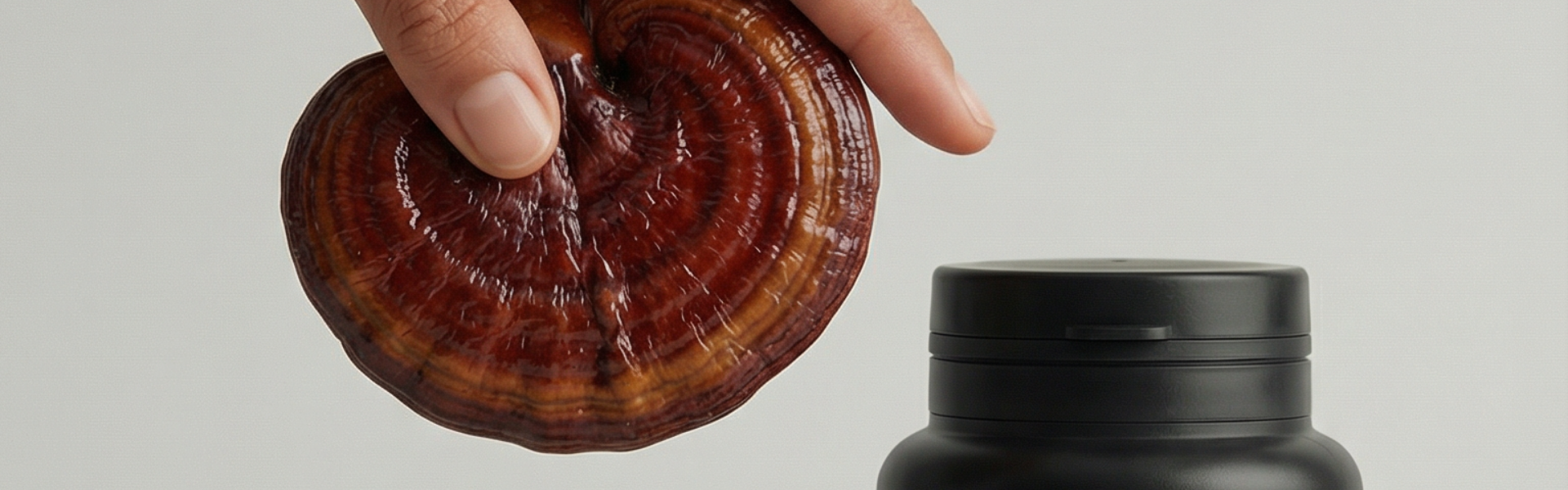
Reishi: The Complete, Evidence-Based Guide
Reishi Mushroom: The Complete, Evidence-Based Guide Reishi shows up everywhere in this category — sleep blends, stress blends, skin blends, "calm" anything. Most of that attention is earned. Some o...
Read more