

The Definitive Guide to Functional Mushrooms: What the Science Actually Says
Everything you need to know about how functional mushrooms work, why extraction method matters, and what separates a supplement worth taking from one that isn't.
Functional mushrooms are not new. Traditional Chinese medicine has documented their use for over 2,000 years. Japanese clinicians have been prescribing mushroom-derived compounds as adjunct cancer therapy since the 1980s. What is new is the rate at which the wellness industry has adopted the language without the substance — selling capsules labelled "Lion's Mane" that contain more grain filler than active compound, at prices that assume you won't check.
This guide is not a list of benefits. It is a map of how functional mushrooms actually work, what the science supports, what it doesn't, and how to tell the difference between a product worth buying and one that is trading on borrowed credibility.
What are functional mushrooms?
Functional mushrooms are fungi that produce bioactive compounds with measurable effects on human physiology beyond basic nutrition. They are distinguished from culinary mushrooms (which are primarily food) and psychedelic mushrooms (which contain psilocybin, a controlled substance) by the specific compounds they contain and how those compounds interact with human biology.
The bioactive compounds in functional mushrooms fall into several categories:
- Beta-glucans — polysaccharides that modulate immune function by binding to receptors on immune cells (primarily Dectin-1 and CR3 receptors). The most studied and clinically significant category.
- Triterpenes — secondary metabolites with anti-inflammatory, adaptogenic and hepatoprotective properties. Particularly concentrated in Reishi.
- Hericenones and erinacines — small molecules found exclusively in Lion's Mane that cross the blood-brain barrier and stimulate Nerve Growth Factor (NGF) synthesis.
- Ergosterol — a precursor to Vitamin D2, present across most functional mushroom species.
- Cordycepin — an adenosine analogue found in Cordyceps that influences cellular energy metabolism via the AMPK pathway.
These compounds do not behave like pharmaceutical drugs — they do not override biological systems. They modulate them. This is both their strength (low side-effect profile, safe for long-term use) and the reason some people "don't feel anything" in the first two weeks. Adaptogenic compounds recalibrate systems that are already under-performing rather than producing acute pharmacological effects.
The difference between fruiting body and mycelium on grain
This is the most important quality question in the functional mushroom supplement market, and most brands would prefer you never asked it.
A mushroom has two main structures. The mycelium is the vegetative network — the root-like system that spreads through substrate and absorbs nutrients. The fruiting body is the mushroom itself — the above-ground structure that produces spores. In nature, the bioactive compounds (particularly beta-glucans) are concentrated in the fruiting body.
When a supplement label says "mycelium on grain," it means the product contains mycelium grown on a grain substrate (usually oats or rice) that was never fully separated from its growing medium. The result is a product that is, by weight, predominantly starch — not mushroom. Studies comparing fruiting body to mycelium on grain have found the fruiting body contains significantly higher concentrations of beta-glucans. A 2022 analysis published in Frontiers in Microbiology found that fruiting body extracts contained up to 4–5x higher beta-glucan concentrations than mycelium biomass grown on grain.
Gribb uses fruiting bodies only. This is not a marketing claim — it is a production decision with direct consequences for potency.
Why extraction method determines bioavailability
A functional mushroom supplement is only as good as its extraction process. Raw dried mushroom powder contains the bioactive compounds — but the cell walls of fungi are made of chitin, the same structural material found in crustacean shells. The human digestive system cannot break down chitin efficiently. Without extraction, most of the bioactive content passes through unabsorbed.
Hot water extraction
Hot water extraction dissolves polysaccharides — primarily beta-glucans — from the mushroom material. This is the method used in traditional mushroom teas and decoctions for thousands of years. It is highly effective for extracting immune-modulating compounds.
Alcohol extraction
Alcohol (ethanol) extraction is required to liberate fat-soluble compounds — primarily triterpenes — that are not water-soluble. Reishi's ganoderic acids (the triterpenes linked to cortisol modulation and adaptogenic effects) require alcohol extraction. A water-only extract of Reishi gives you the beta-glucans but misses the triterpenes entirely.
Dual extraction
Dual extraction combines both processes sequentially, capturing the full bioactive spectrum of the mushroom. It is more labour-intensive and more expensive to produce. It is also the only extraction method that delivers the complete compound profile the research was conducted on.
The nine functional mushrooms you should know
Lion's Mane
Hericium erinaceusLion's Mane is the most studied functional mushroom for cognitive function. It contains hericenones (in the fruiting body) and erinacines (in the mycelium) — compounds that stimulate the synthesis of Nerve Growth Factor and Brain-Derived Neurotrophic Factor. NGF is essential for the maintenance, growth, and survival of neurons. Declining NGF is associated with neurodegenerative conditions including Alzheimer's disease.
A 2019 double-blind, placebo-controlled trial in Phytotherapy Research found that older adults taking 3g/day of Lion's Mane powder for 16 weeks showed significant improvement in cognitive function scores compared to placebo, with effects reversing after supplementation stopped. A 2023 study in Neurochemical Research demonstrated that compounds in Lion's Mane promoted new hippocampal neuron growth in animal models.
- Hericenones
- Erinacines
- Beta-glucans
- NGF stimulation
- BDNF support
Reishi
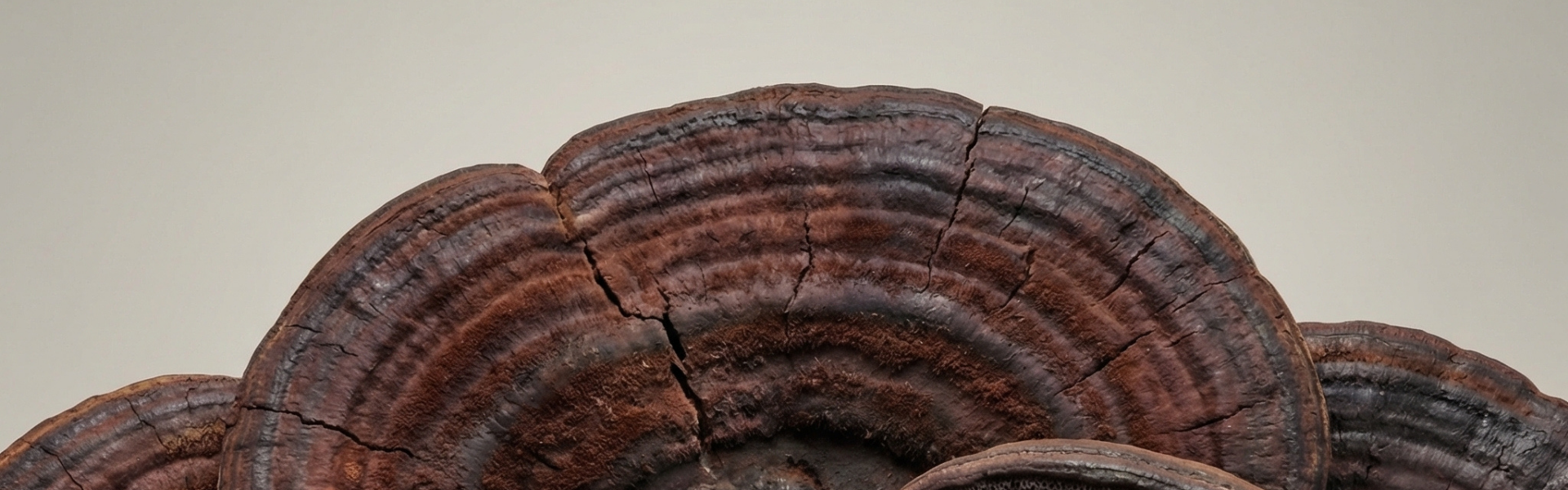
Ganoderma lucidumReishi has the broadest documented bioactive profile of any functional mushroom — over 400 distinct compounds identified, including more than 100 unique triterpenes (ganoderic acids). These triterpenes are the primary driver of Reishi's adaptogenic and cortisol-modulating effects. Ganoderic acids inhibit HMG-CoA reductase (the same enzyme targeted by statin drugs), modulate the HPA axis stress response, and demonstrate hepatoprotective activity in multiple animal and in vitro studies.
Reishi's beta-glucans also demonstrate significant immunomodulatory effects. A 2018 systematic review in Medicine concluded that Ganoderma lucidum supplementation was associated with enhanced natural killer cell activity. Reishi requires alcohol extraction to access the triterpene fraction — water-only extracts miss the most pharmacologically active compounds.
- Ganoderic acids
- Triterpenes
- Beta-glucans
- HPA modulation
- NK cell activity
Cordyceps
Cordyceps militaris / sinensisCordyceps is best understood as a cellular energy mushroom. Its primary active compound, cordycepin (3'-deoxyadenosine), is an adenosine analogue that activates AMPK — adenosine monophosphate-activated protein kinase — the master metabolic regulator in human cells. AMPK activation increases ATP production, improves mitochondrial efficiency, and enhances oxygen utilisation. This is why Cordyceps has the strongest evidence base for physical performance and endurance among the functional mushrooms.
A 2016 randomised trial in Journal of Dietary Supplements found that Cordyceps supplementation over 3 weeks significantly improved VO2 max and time to exhaustion in older adults. Cordyceps militaris (cultivated) contains comparable or higher cordycepin concentrations to wild Cordyceps sinensis at a fraction of the cost and with consistent quality.
- Cordycepin
- Adenosine
- AMPK activation
- Beta-glucans
- VO2 max
Chaga
Inonotus obliquusChaga is a parasitic fungus that grows primarily on birch trees in cold northern climates. Its most distinctive compound is betulinic acid, derived from the birch substrate, which demonstrates antitumour and anti-inflammatory properties in multiple in vitro studies. Chaga also contains the highest known ORAC (antioxidant capacity) score of any natural food — driven primarily by melanin pigments and superoxide dismutase (SOD) activity.
Critically: substrate matters enormously for Chaga. Chaga grown on birch contains betulinic acid. Chaga grown on other substrates does not. This is a direct consequence of the parasite-host relationship — Chaga absorbs and concentrates birch compounds. Most Chaga supplements do not disclose substrate origin.
- Betulinic acid
- Melanin
- SOD
- Beta-glucans
- Antioxidants
Mesima
Phellinus linteusMesima is one of the most respected medicinal fungi in East Asian clinical tradition — used for centuries in Korean, Chinese and Japanese medicine, and one of the rarest mushrooms in Gribb's range. Its primary bioactive compounds are hispolon and a broad spectrum of polysaccharides including unique beta-glucans that activate macrophages, natural killer (NK) cells, and T-cells through pattern recognition pathways distinct from other functional mushrooms. This immunological specificity makes Mesima genuinely complementary to species like Reishi rather than redundant.
Mesima is also one of the few functional mushrooms with peer-reviewed in vitro evidence for inhibiting cancer cell proliferation — specifically in breast, prostate, and lung cancer cell lines — attributed to its ability to enhance immune surveillance and induce apoptosis. It grows naturally on mulberry trees; substrate origin directly affects its hispolon and flavonoid concentration, which is why Gribb's wood-based cultivation protocol matters for this species specifically.
Note: Turkey Tail (Trametes versicolor), though widely referenced in international mushroom research, is classified as a Novel Food in the EU and cannot be legally sold as a food supplement in Europe. Mesima offers comparable and complementary immunomodulatory activity within EU regulatory compliance.
- Hispolon
- Beta-glucans
- Flavonoids
- NK cell activation
- Macrophage activation
- Apoptosis induction
Maitake
Grifola frondosaMaitake — "dancing mushroom" in Japanese — contains one of the most structurally unique beta-glucan fractions in the functional mushroom category: the D-fraction, a 1,3/1,6-beta-D-glucan with particularly high affinity for immune cell receptors. D-fraction has been studied for immune potentiation in cancer adjunct therapy settings, with a 2009 pilot study in Journal of the Society for Integrative Oncology finding evidence of immune response enhancement in breast cancer patients.
Beyond immune function, Maitake has the strongest evidence base of the functional mushrooms for metabolic health — specifically insulin sensitivity and glucose metabolism. A 2015 study in the Journal of Diabetes found that Maitake supplementation improved insulin receptor sensitivity in type 2 diabetic patients. Its SX-fraction polysaccharide has been specifically studied for this metabolic mechanism. For audiences dealing with hormonal fluctuations — perimenopause in particular, where insulin sensitivity shifts — Maitake is the metabolic anchor in the Gribb range.
- D-fraction beta-glucan
- SX-fraction
- 1,3/1,6-beta-glucan
- Insulin sensitivity
- NK cell activation
Shiitake
Lentinula edodesShiitake is the most widely consumed functional mushroom globally — but its reputation as a culinary species often obscures its substantial clinical evidence base. Its primary bioactive compound, lentinan (a 1,3-beta-D-glucan), is an approved adjunct cancer therapy in Japan and has been in clinical use since the 1980s. Lentinan is administered intravenously in oncological settings; oral supplementation with high-quality fruiting body extract delivers it via the gut-associated immune system.
Shiitake also contains eritadenine, a compound that inhibits an enzyme involved in cholesterol synthesis — with a different mechanism to statins — and AHCC (Active Hexose Correlated Compound), a proprietary fraction derived from Shiitake mycelium that has been studied specifically for immune function in multiple randomised trials. For regular supplementation, Shiitake's combination of lentinan, eritadenine, and broad polysaccharide content makes it the most nutritionally complete mushroom in the Gribb range.
- Lentinan
- Eritadenine
- AHCC precursor
- 1,3-beta-D-glucan
- Cholesterol modulation
Agaricus Blazei
Agaricus subrufescensAgaricus Blazei originated in the Piedade region of Brazil, where local populations showed unusually low rates of adult-onset disease — an observation that drove Japanese researchers to study its composition intensively from the 1960s onwards. It contains the highest beta-glucan concentration of any cultivated functional mushroom by dry weight — with particularly high concentrations of 1,6-beta-glucan fractions that activate immune cells through mechanisms complementary to the 1,3-beta-glucans dominant in most other species.
A 2011 randomised, double-blind trial in the Journal of Alternative and Complementary Medicine found that Agaricus Blazei extract significantly enhanced NK cell activity in healthy subjects over 90 days. It also contains high concentrations of ergosterol (provitamin D2) and a unique set of sterols not found in other functional mushrooms. For immune depth and breadth, Agaricus Blazei is the most potent species in the Gribb range by beta-glucan concentration.
- 1,6-beta-glucan
- Ergosterol
- Blazeispirol sterols
- NK cell activation
- Highest beta-glucan content
Tremella
Tremella fuciformisTremella is distinct from the other functional mushrooms in this guide — its primary benefits are dermatological rather than systemic. Its polysaccharides have a molecular structure that holds up to 500 times their weight in water, enabling deep cellular hydration of skin tissue. Unlike hyaluronic acid (molecular weight ~1 MDa, which sits primarily on the skin surface), Tremella polysaccharides have a smaller molecular size that allows deeper penetration into the dermis.
A 2021 study in International Journal of Biological Macromolecules confirmed Tremella's superior moisture retention compared to hyaluronic acid under controlled humidity conditions. Tremella also demonstrates significant UV protection activity — potentially relevant for Algarve-based consumers exposed to high solar radiation year-round.
- Tremella polysaccharides
- Glucuronoxylomannan
- Hyaluronic-like activity
- UV protection
Why origin and substrate matter more than the label
The functional mushroom supplement market has a sourcing problem. The majority of extracts on the European market are produced from mushrooms grown on grain-based substrates in large industrial facilities, predominantly in China. This is not inherently problematic — but it becomes problematic when:
- Substrate origin is not disclosed
- Extraction method is not specified
- Beta-glucan content is not tested or published
- Mycelium biomass is labelled as mushroom extract
The functional compounds in mushrooms are not fixed by species alone. They are influenced by the growing substrate (what the mushroom eats), environmental conditions (humidity, temperature, light cycles), the stage of harvest (early vs late fruiting body), and extraction method. A Lion's Mane extract from a fruiting body grown on hardwood substrate will have a different bioactive profile — and a higher one — than the same species grown on oat grain and sold as "mycelium biomass."
Gribb grows on wood-based sawdust substrate sourced from local woodshops in the Monchique mountain range, 40km from our facility. This is the substrate that Lion's Mane, Reishi, and the other wood-loving species in our range evolved to grow on. The substrate is not a branding choice — it is a bioactive choice.
What does PT-BIO-10 certification mean?
PT-BIO-10 is Portugal's national organic certification standard, administered by NATURALFA, one of Portugal's three accredited organic certification bodies under EU Regulation 2018/848. Achieving and maintaining PT-BIO-10 certification requires:
- Full traceability from substrate origin through to finished product
- No synthetic inputs at any stage of production
- Regular third-party contamination testing
- Annual on-site audits of growing and processing facilities
- Documentation of all production processes
Gribb holds PT-BIO-10 certification for its Portimão facility. This means every product you purchase from Gribb has a documented, audited supply chain from substrate to extract to bottle. We did not seek this certification for marketing purposes — we sought it because it is the most rigorous external validation available in our market.
How long does it take to notice a difference?
This is the question we get asked most, and the honest answer is: it depends on which mushroom, why you're taking it, and what your baseline is.
Cordyceps effects on physical performance and energy are typically noticeable within 2–3 weeks of consistent daily use. This is because Cordyceps works through AMPK activation — a relatively acute cellular mechanism.
Lion's Mane effects on cognition and clarity build more gradually — most people report meaningful shifts at 4–6 weeks, with effects continuing to develop at 8–12 weeks. NGF stimulation requires time to produce structural neuronal changes.
Reishi's adaptogenic effects — improved stress resilience, sleep quality, reduced cortisol reactivity — are typically the slowest to manifest and the most dependent on dosage consistency. Most people report meaningful changes at 6–8 weeks. The clinical trial data consistently uses 8–12 week protocols.
One consistent pattern we observe in our customers: people notice the absence of Gribb more clearly than they noticed its presence. When they stop — by design, by travel, by running out — they report within a week that something has shifted back. This is perhaps the most honest measure of efficacy available to us without clinical trial infrastructure.
References
- Mori K, et al. (2009). Improving effects of the mushroom Yamabushitake (Hericium erinaceus) on mild cognitive impairment: a double-blind placebo-controlled clinical trial. Phytotherapy Research, 23(3), 367–372.
- Vigna L, et al. (2019). Hericium erinaceus Improves Mood and Sleep Disorders in Patients Affected by Overweight or Obesity: Could Circulating Pro-BDNF and BDNF Be Potential Biomarkers? Evidence-Based Complementary and Alternative Medicine.
- Jiang S, et al. (2022). Comparison of beta-glucan content between fruiting body and mycelium biomass of Hericium erinaceus. Frontiers in Microbiology, 13.
- Jin X, et al. (2016). Ganoderma lucidum (Reishi mushroom) for cancer treatment (Review). Cochrane Database of Systematic Reviews.
- Gao Y, et al. (2018). Effects of Ganoderic Acid from Ganoderma lucidum on immune function. Medicine, 97(26).
- Zhu T, et al. (2015). Phellinus linteus: review of ethnopharmacology, phytochemistry and pharmacology. Journal of Asian Natural Products Research, 17(1), 62–80.
- Zhao YY, et al. (2013). Hispolon from Phellinus linteus induces G0/G1 cell cycle arrest in human uterine sarcoma cells. Oncology Reports.
- Nanba H, et al. (1993). Maitake D-fraction: healing and preventing potentials for cancer. Journal of Naturopathic Medicine, 1, 10–15.
- Lo HC, et al. (2008). The anti-hyperglycemic activity of the fruiting body of Grifola frondosa. Journal of Diabetes.
- Ngai PHK, et al. (2003). Lentin, a novel and potent antifungal protein from shiitake mushroom. Biochemical and Biophysical Research Communications.
- Ito H, et al. (1997). Antitumor effects of a new polysaccharide-protein complex (ATOM) prepared from Agaricus blazei. Anticancer Research.
- Hetland G, et al. (2011). The mushroom Agaricus blazei Murill elicits medicinal effects on tumor, inflammation, allergy, asthma, and infection. Journal of Alternative and Complementary Medicine.
- Hirsch KR, et al. (2016). Cordyceps militaris improves tolerance to high-intensity exercise after acute and chronic supplementation. Journal of Dietary Supplements.
- Zheng X, et al. (2021). Comparative evaluation of hyaluronic acid and Tremella fuciformis polysaccharide on skin moisture retention. International Journal of Biological Macromolecules.
- Lee KH, et al. (2015). The therapeutic potential of Inonotus obliquus (Chaga) fungus. Journal of Ethnopharmacology, 164, 499–502.
- Wasser SP (2017). Medicinal mushrooms in human clinical studies. Part I. Anticancer, oncoimmunological, and immunomodulatory activities: A review. International Journal of Medicinal Mushrooms, 19(4), 279–317.
Read more
The Vagus Nerve: The Missing Piece in Every Wellness Conversation
You've probably noticed that the wellness world has started talking about something called the vagus nerve. It sounds technical, maybe even obscure. But if there's one concept that can genuinely sh...
Read more
The Cortisol Cocktail, Fact-Checked: What's In It and Does It Work
If you've spent any time on TikTok lately, you've seen it: a bright orange drink, a confident voice telling you it'll "lower your cortisol," and a comment section full of people asking where to buy...
Read more