



Perimenopause and Functional Mushrooms: What No One Told You
You didn't get a memo.
One day you were fine — managing work, sleep, stress, all of it — and then somewhere around your late thirties or forties, things started quietly shifting. Sleep became unreliable. Anxiety appeared from nowhere. Your energy had a ceiling you'd never noticed before. Brain fog settled in like weather.
Your doctor may have told you this is normal. And technically, it is. But normal doesn't mean you have to just push through it.
Perimenopause — the transition phase that can begin up to ten years before your last period — is one of the most underserved chapters in women's health. The hormonal shifts are real, the symptoms are real, and the support most women receive is almost nonexistent.
That's where functional mushrooms come in. Not as a miracle fix. Not as a replacement for medical care. But as something your nervous system genuinely needs during one of the most demanding biological transitions of your life.
What's actually happening in your body
During perimenopause, oestrogen and progesterone begin their long, uneven decline. But it's not a clean descent — it's chaotic. Levels spike, drop, and fluctuate in ways that affect almost every system in your body: your sleep architecture, your stress response, your mood regulation, your cognitive clarity.
The reason so many symptoms cluster together isn't coincidence. It's because oestrogen has receptors throughout the brain and nervous system. When its availability becomes unpredictable, so does everything it regulates.
The result is a nervous system under pressure — trying to maintain balance while the hormonal inputs it relies on keep changing the rules.
Why your nervous system is the entry point
Most conversations about perimenopause focus on hormones. Which makes sense. But the nervous system is where you actually feel the impact.
The hypothalamic-pituitary-adrenal (HPA) axis — your body's central stress management system — is deeply sensitive to hormonal fluctuation. When oestrogen drops, the HPA axis becomes more reactive. Cortisol rises more easily. The threshold for the stress response lowers.
This is why perimenopausal women often experience:
- Waking at 3am with a racing mind, unable to get back to sleep
- Anxiety that feels disproportionate to the situation
- A general sense of being wired but exhausted at the same time
- Emotional reactivity that feels unfamiliar
These aren't personality changes. They're nervous system responses to a hormone environment that keeps shifting.
Supporting the nervous system directly — rather than waiting for hormone levels to stabilise on their own — is one of the most practical things you can do during this transition.
Where functional mushrooms fit in
Functional mushrooms have been used in traditional wellness practices for thousands of years. Modern research is now exploring the mechanisms behind what those traditions observed — and several mushrooms show particular relevance for the specific pressures of perimenopause.
Reishi (Ganoderma lucidum) is one of the most studied mushrooms in traditional use, historically associated with supporting calm and restful sleep. Research has explored its beta-glucan content and its potential interaction with the nervous system. It's the mushroom most often associated with the kind of deep, sustained relaxation that feels different from sedation — not switched off, just quieter.
Lion's Mane (Hericium erinaceus) is the focus of significant scientific interest for its potential role in cognitive support. For perimenopausal women experiencing brain fog, word-finding difficulties, or a general sense that their thinking isn't as sharp as it was, this is a mushroom worth understanding.
Cordyceps (Cordyceps ) has traditional use associations with energy and vitality. The particular kind of energy depletion that accompanies perimenopause — not laziness, not poor sleep hygiene, but a deep cellular fatigue — is the context in which Cordyceps has historically been used.
It's important to note: under EU regulations, we don't make health claims about our products. What we can tell you is what these mushrooms have been used for traditionally, and what researchers are currently exploring. What you do with that information is your own informed decision.
Why a drink format makes sense
There's a practical argument for getting your functional mushrooms through a beverage rather than capsules alone — especially during perimenopause.
The nervous system shift that happens in perimenopause is partly about rhythm. Sleep rhythm. Cortisol rhythm. The rituals you build around morning and evening are more than habit — they're nervous system cues. A consistent routine signals safety to a system that's been running on high alert.
A functional mushroom drink built into your morning or evening ritual isn't just delivering active compounds. It's creating a pause. A moment of intention. That matters more than it sounds when your nervous system has been spending months in a state of low-grade hypervigilance.
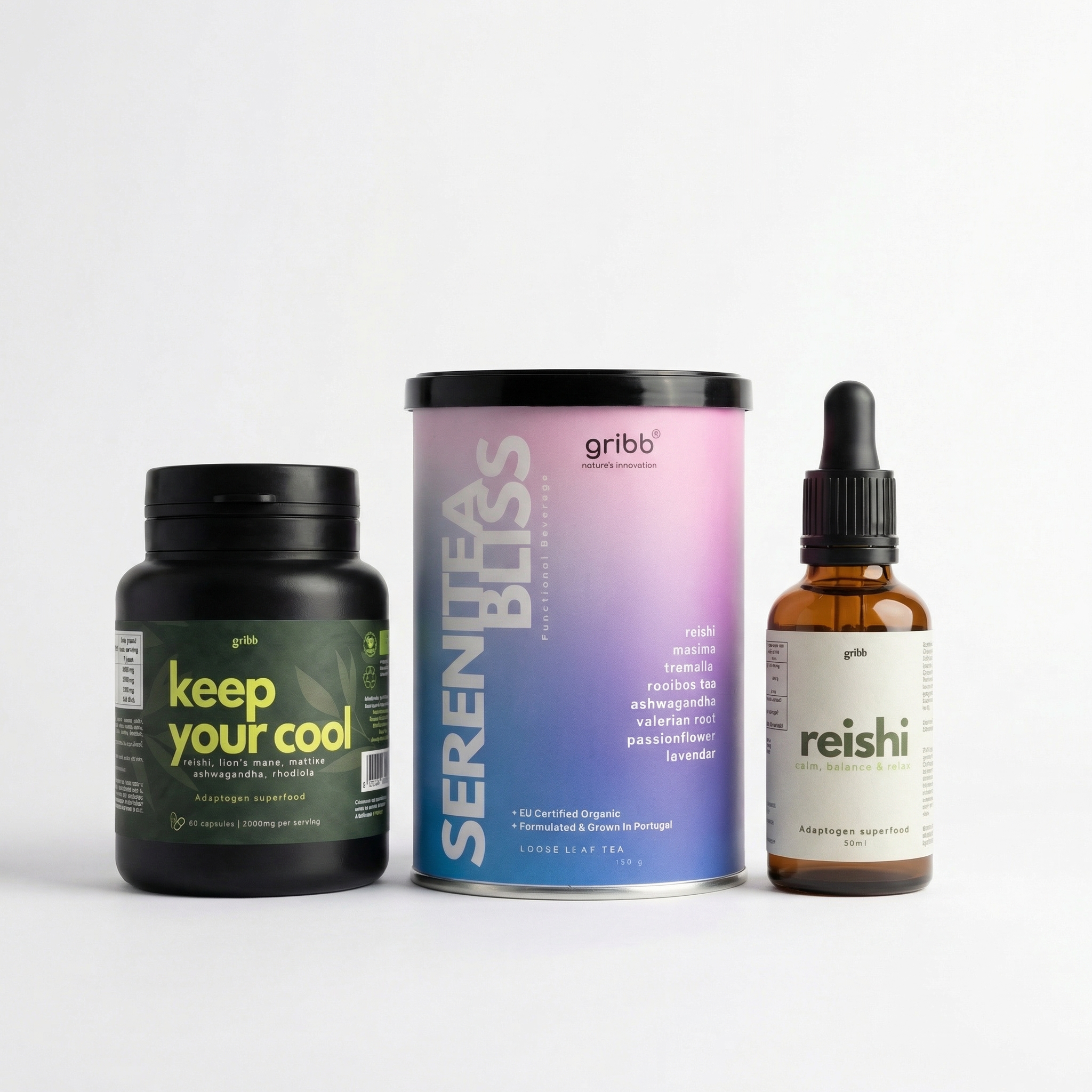
Our NightCup was formulated specifically for the evening ritual — Reishi, alongside other botanicals chosen for their traditional associations with unwinding and supporting sleep. Serentea Bliss brings Lion's Mane and Reishi together in a format designed for the moments between the demands of the day.
Neither is a sedative. Neither is a pharmaceutical intervention. They're tools for a nervous system that needs support, not suppression.
What to look for in a functional mushroom drink
Not all functional mushroom products are equivalent. A few things worth understanding before you buy:
Whole fruiting body vs mycelium on grain. The mushroom's active compounds — beta-glucans, triterpenes, and other constituents — are concentrated in the fruiting body. Many cheaper products use myceliated grain, which contains significantly less of the active compounds. Always check.
Dual extraction. Some compounds are water-soluble. Others are not. A proper dual extraction — water and alcohol — ensures you're getting the full spectrum of what the mushroom contains. Single-process extracts leave a significant portion behind.
Organic certification. Mushrooms are bioaccumulators — they absorb what's in their growing environment. Organic certification isn't a marketing badge. It's a meaningful indicator of what you're not getting alongside the mushrooms.
Gribb products are certified organic (PT-BIO-10), made from whole fruiting bodies, and dual-extracted. These aren't claims we make to sound good — they're the baseline we hold ourselves to because anything less isn't worth your money or your trust.
What to expect
Functional mushrooms aren't fast-acting interventions. They work over time, with consistency. Most people who find them genuinely useful report that the changes are subtle at first — a slightly easier descent into sleep, a stress response that feels a little less extreme, a morning that starts with less friction.
If you're expecting a dramatic shift in week one, you may be disappointed. If you're willing to give it six to eight weeks with consistency, you're giving yourself a fair chance to notice what changes.
Perimenopause is a long game. The tools that serve you best in it are the ones you can sustain.
The bottom line
Your nervous system isn't broken. It's adapting to a genuine biological transition — one that the wellness industry has largely ignored, and that conventional medicine often manages with blunt instruments.
Functional mushrooms won't replace oestrogen. They won't eliminate your symptoms. But for a nervous system under the particular pressure of perimenopause, they offer something worth considering: traditional tools with a growing body of modern research behind them, in a format you can build into the rhythms of your daily life.
That's not nothing. During a transition this significant, that's actually quite a lot.
Explore Gribb's functional beverages — formulated for the nervous system, made from certified organic whole fruiting body mushrooms.
References
- Bromberger, J. T., & Epperson, C. N. (2018). Depression during and after the perimenopause: impact of hormones, sleep, and menopause symptoms. Obstetrics and Gynecology Clinics of North America, 45(4), 663–678. https://doi.org/10.1016/j.ogc.2018.07.007
- Santoro, N., Epperson, C. N., & Mathews, S. B. (2015). Menopausal symptoms and their management. Endocrinology and Metabolism Clinics of North America, 44(3), 497–515. https://doi.org/10.1016/j.ecl.2015.05.001
- Wicks, S. M., & Tong, R. (2005). Ganoderma lucidum and the HPA axis: preclinical findings. Alternative Therapies in Health and Medicine, 11(1), 30–35.
- Cui, X. Y., Cui, S. Y., Zhang, J., et al. (2012). Extract of Ganoderma lucidum prolongs sleep time in rats. Journal of Ethnopharmacology, 139(3), 796–800. https://doi.org/10.1016/j.jep.2011.12.020
- Mori, K., Inatomi, S., Ouchi, K., Azumi, Y., & Tuchida, T. (2009). Improving effects of the mushroom Yamabushitake (Hericium erinaceus) on mild cognitive impairment: a double-blind placebo-controlled clinical trial. Phytotherapy Research, 23(3), 367–372. https://doi.org/10.1002/ptr.2634
- Chong, P. S., Fung, M. L., Wong, K. H., & Lim, L. W. (2020). Therapeutic potential of Hericium erinaceus for depressive disorder. International Journal of Molecular Sciences, 21(1), 163. https://doi.org/10.3390/ijms21010163
- Chen, S., Li, Z., Krochmal, R., Abrazado, M., Kim, W., & Cooper, C. B. (2010). Effect of Cs-4 (Cordyceps sinensis) on exercise performance in healthy older subjects. Journal of Alternative and Complementary Medicine, 16(5), 585–590. https://doi.org/10.1089/acm.2009.0226
- Vighi, G., Marcucci, F., Sensi, L., Di Cara, G., & Frati, F. (2008). Allergy and the gastrointestinal system. Clinical & Experimental Immunology, 153(Suppl 1), 3–6. https://doi.org/10.1111/j.1365-2249.2008.03713.x
Read more

Why Your Nervous System Feels "Off" Even When Life Looks Fine
You can't point to anything specifically wrong. Your job is fine. Your relationships are okay. Nothing dramatic has happened. And yet — you feel off. There's a persistent background hum of unease. ...
Read more
The Best Mushroom Powders for Stress — Ranked by Evidence
Here's the problem with the functional mushroom market right now. Everyone is selling you a powder. Influencers are adding it to their lattes. Wellness brands are slapping "adaptogen" on the label ...
Read more