


The Best Mushroom Powders for Stress — Ranked by Evidence
Here's the problem with the functional mushroom market right now.
Everyone is selling you a powder. Influencers are adding it to their lattes. Wellness brands are slapping "adaptogen" on the label and charging forty euros for what amounts to ground grain with a mushroom photo on the front.
And somewhere in all that noise, the actual science — thousands of years of traditional use now backed by a growing body of modern research — is getting lost.
This article is not a sales pitch. It's a breakdown of which mushroom powders have the most meaningful evidence behind them for stress and anxiety support, what the research actually says, what it doesn't say, and what you should look for before you spend a single cent.
First: what "stress" actually means for your body
Stress isn't just a feeling. It's a physiological cascade.
When your brain perceives a threat — whether that's a deadline, a difficult conversation, or three years of accumulated pressure — it activates the hypothalamic-pituitary-adrenal (HPA) axis. Cortisol is released. Heart rate increases. Digestion slows. Immune function depresses.
In short bursts, this is useful. The problem is that modern life has turned what should be a short-term emergency response into a chronic background state. The HPA axis stays activated. Cortisol stays elevated. The body never fully returns to baseline.
The downstream effects include poor sleep, low mood, impaired cognitive function, hormonal disruption, and a general sense of depletion that no amount of rest seems to fix.
This is the context in which functional mushroom powders are being used — and why understanding which ones do what matters.
The mushrooms with the strongest evidence for stress support
Reishi (Ganoderma lucidum)
If there is one mushroom that has historically been associated with calm, it is Reishi. Used for over two thousand years in East Asian traditional medicine — known as the "mushroom of immortality" — its modern research profile is substantial.
Reishi contains triterpenes (specifically ganoderic acids) and beta-glucans, both of which have been the subject of significant scientific investigation. Research has explored its potential interactions with the nervous system and the HPA axis. Studies have looked at its effects on sleep quality, immune modulation, and the kind of fatigue that accompanies chronic stress.
In traditional use, Reishi was specifically associated with what practitioners called "shen" — roughly translated as spirit or mental calm. The modern research is beginning to offer mechanistic explanations for what traditional practice observed.
Best used for: the wired-but-exhausted state, sleep disruption driven by an overactive mind, long-term stress accumulation.
Lion's Mane (Hericium erinaceus)
Lion's Mane is perhaps the most researched functional mushroom for cognitive function, and the anxiety-cognition connection is more direct than most people realise.
Chronic stress impairs the prefrontal cortex — the part of the brain responsible for rational thinking, decision-making, and emotional regulation. It also reduces neuroplasticity: the brain's ability to form new connections and recover from stress. When you're anxious, part of what you're experiencing is a nervous system that has lost some of its adaptive capacity.
Lion's Mane contains hericenones and erinacines, compounds that have been the subject of research for their potential role in supporting nerve growth factor (NGF). NGF is involved in the maintenance and growth of neurons. Research has also explored Lion's Mane's potential effects on mild anxiety and mood in clinical settings.
Best used for: stress-related brain fog, cognitive sharpness under pressure, anxiety that manifests as mental overwhelm rather than physical tension.
Cordyceps (Cordyceps )
Cordyceps occupies a different position in the stress conversation. It's less about calming the nervous system and more about addressing the energy depletion that chronic stress creates.
When the HPA axis has been running on high for an extended period, the adrenal glands fatigue. Cortisol output becomes dysregulated. The result is the particular kind of exhaustion where sleep doesn't restore you — because the system producing your energy hormones is itself depleted.
Cordyceps has traditional use associations with vitality and stamina, and modern research has explored its potential effects on ATP production at the cellular level — essentially, how efficiently your cells produce and use energy. It has also been the subject of research for its potential adaptogenic properties.
Best used for: stress-driven energy depletion, the exhaustion that follows a prolonged high-stress period, recovery of baseline energy.
Chaga (Inonotus obliquus)
Chaga is the most antioxidant-dense mushroom in the functional category. Its relevance to stress is indirect but meaningful — chronic stress generates significant oxidative damage at the cellular level. The free radical load produced by sustained HPA axis activation has downstream effects on cellular health, cognitive function, and immune resilience.
Chaga's polyphenol and melanin content (specifically eumelanin from indoor cultivation) has been the subject of research for antioxidant activity. It sits more naturally in a long-term support role than as an acute stress intervention.
Best used for: long-term oxidative load from chronic stress, immune support during high-stress periods.
What the science does and doesn't say
We need to be direct here, because the functional mushroom market is full of overclaiming.
Under EU Regulation 1924/2006, health claims for food products must be authorised by EFSA. Currently, no functional mushroom has an approved health claim in the EU for anxiety, stress, or cognitive function. That means any brand making those claims directly is operating outside the law.
What the research does show is a growing body of preclinical and clinical studies exploring the mechanisms and potential effects of these mushrooms. Many of those studies are promising. Many are small or preliminary. The traditional use record — thousands of years across multiple cultures — adds meaningful context.
At Gribb, we don't make health claims. We tell you what these mushrooms have been used for traditionally, and we point you toward the research so you can make your own informed decision. That's not a legal workaround. It's respect for your intelligence.
How to read a mushroom powder label
The powder market is genuinely difficult to navigate. Here's what actually matters:
Beta-glucan content. Beta-glucans are the primary active compounds in functional mushrooms. A good powder will list the beta-glucan percentage on the label. If it doesn't, ask why. Anything below 20% should prompt questions.
Whole fruiting body vs mycelium on grain. This is the single biggest quality differentiator in the market. Whole fruiting body powders are made from the actual mushroom. Mycelium-on-grain products are made from the root-like network grown on a grain substrate — they contain significantly less of the active compounds and significantly more starch. Many US-market products use mycelium on grain. Check the label carefully.
Extraction method. Raw mushroom powder is not the same as extracted powder. The cell walls of mushrooms (chitin) are largely indigestible by humans. Without extraction — at minimum hot water extraction, ideally dual extraction with alcohol — many of the active compounds pass through your system without being absorbed. Look for "extract" on the label, not just "powder."
Organic certification. Mushrooms bioaccumulate — they absorb heavy metals, pesticides, and other compounds from their growing medium. Certified organic mushrooms (look for EU organic certification symbols) give you meaningful assurance about what's not in the product.
Gribb powders: what makes them different
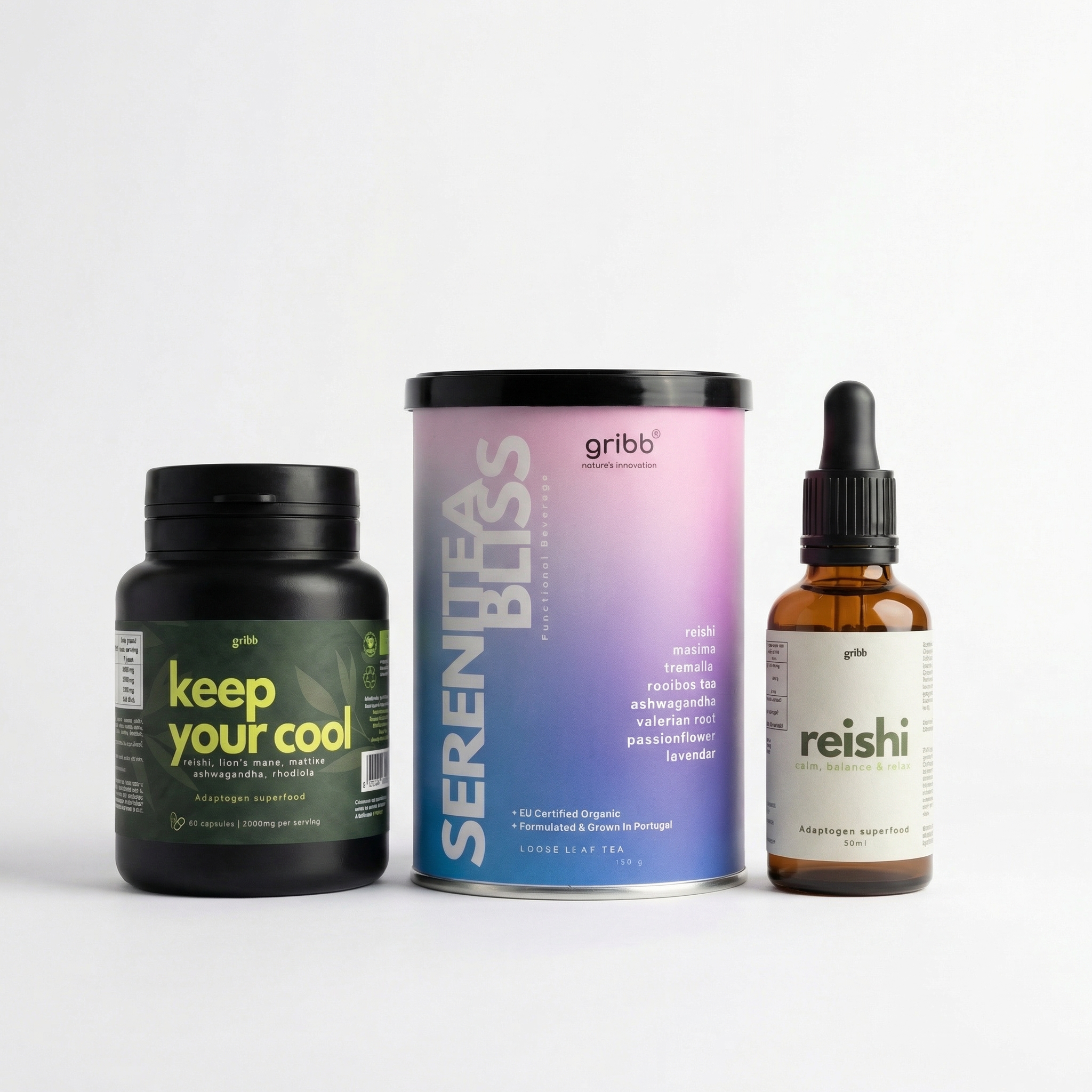
Gribb mushroom powders are made from certified organic whole fruiting bodies (PT-BIO-10), dual-extracted, and independently tested. The cultivation happens on our own indoor farm in Portugal — which means full traceability from substrate to shelf.
We don't sell powders as a stress cure. We sell them as a tool — one part of a larger approach to supporting the nervous system with what nature has been offering for thousands of years.
The bottom line
The best mushroom powder for stress depends on what your stress actually looks like.
For the wired-but-exhausted, sleep-disrupted pattern: Reishi. For cognitive fog, mental overwhelm, and anxiety that lives in the head: Lion's Mane. For deep energy depletion after a prolonged high-stress period: Cordyceps. For long-term oxidative support during chronic stress: Chaga.
Most people dealing with chronic stress benefit from more than one. That's not upselling — it's biology. Stress is not a single-system problem.
Start with the mushroom that most accurately describes your current experience. Give it six to eight weeks of consistent use. Pay attention to what changes.
References
- Bhatt, D., & Bhattacharyya, S. (2019). Adaptogenic potential of Ganoderma lucidum: a review. Journal of Ethnopharmacology, 231, 492–505. https://doi.org/10.1016/j.jep.2018.12.004
- Cui, X. Y., Cui, S. Y., Zhang, J., et al. (2012). Extract of Ganoderma lucidum prolongs sleep time in rats. Journal of Ethnopharmacology, 139(3), 796–800. https://doi.org/10.1016/j.jep.2011.12.020
- Mori, K., Inatomi, S., Ouchi, K., Azumi, Y., & Tuchida, T. (2009). Improving effects of the mushroom Yamabushitake (Hericium erinaceus) on mild cognitive impairment: a double-blind placebo-controlled clinical trial. Phytotherapy Research, 23(3), 367–372. https://doi.org/10.1002/ptr.2634
- Vigna, L., Morelli, F., Agnelli, G. M., et al. (2019). Hericium erinaceus improves mood and sleep disorders in patients affected by overweight or obesity. Evidence-Based Complementary and Alternative Medicine, 2019, 7861297. https://doi.org/10.1155/2019/7861297
- Chen, S., Li, Z., Krochmal, R., Abrazado, M., Kim, W., & Cooper, C. B. (2010). Effect of Cs-4 (Cordyceps sinensis) on exercise performance in healthy older subjects. Journal of Alternative and Complementary Medicine, 16(5), 585–590. https://doi.org/10.1089/acm.2009.0226
- Hirsch, K. R., Smith-Ryan, A. E., Roelofs, E. J., Trexler, E. T., & Mock, M. G. (2017). Cordyceps militaris improves tolerance to high-intensity exercise after acute and chronic supplementation. Journal of Dietary Supplements, 14(1), 42–53. https://doi.org/10.1080/19390211.2016.1203386
- Géry, A., Dubreule, C., André, V., et al. (2018). Chaga (Inonotus obliquus), a future potential medicinal fungus in oncology? Integrative Cancer Therapies, 17(3), 832–838. https://doi.org/10.1177/1534735418757912
- McEwen, B. S. (2008). Central effects of stress hormones in health and disease: understanding the protective and damaging effects of stress and stress mediators. European Journal of Pharmacology, 583(2–3), 174–185. https://doi.org/10.1016/j.ejphar.2007.11.071
- Talbott, S. M., & Talbott, J. A. (2012). Effect of beta 1,3/1,6 glucan on upper respiratory tract infection symptoms and mood state in marathon athletes. Journal of Sports Science and Medicine, 11(2), 367–375.
Read more

Perimenopause and Functional Mushrooms: What No One Told You
You didn't get a memo. One day you were fine — managing work, sleep, stress, all of it — and then somewhere around your late thirties or forties, things started quietly shifting. Sleep became unrel...
Read more
The Vagus Nerve: The Missing Piece in Every Wellness Conversation
You've probably noticed that the wellness world has started talking about something called the vagus nerve. It sounds technical, maybe even obscure. But if there's one concept that can genuinely sh...
Read more