

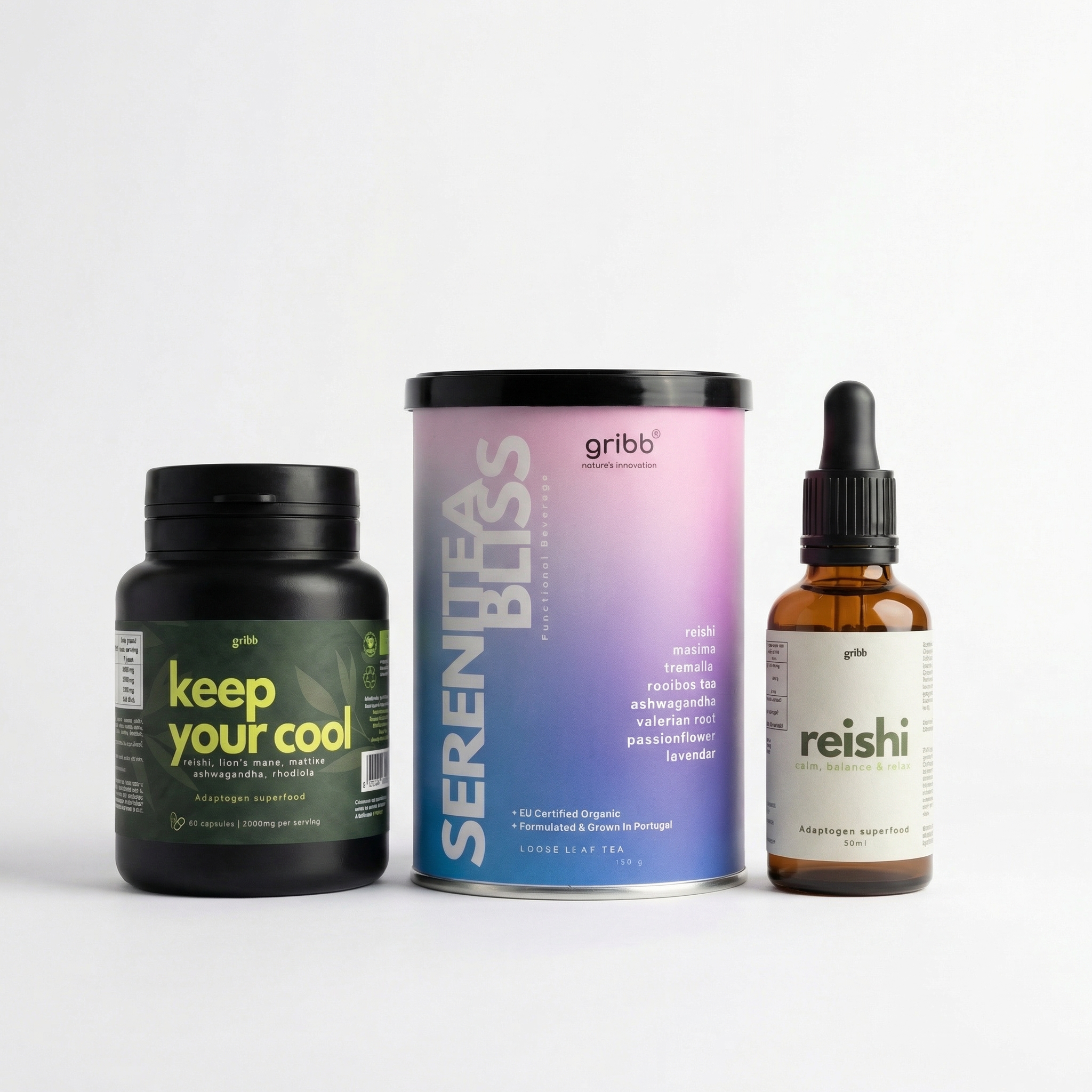

If you've started looking into functional mushrooms, you've probably ended up on a landing page offering you an eleven-product stack, three adaptogens, a nootropic, and a subscription box. It's a lot. It's also, almost certainly, more than you need.
There's a version of functional wellness that's genuinely useful and calm and sustainable. It doesn't require a spreadsheet. It requires three good things, taken consistently, that address the actual dimensions of how your body functions day-to-day.
This is that version.
Why most functional mushroom routines fail
The most common mistake people make when starting a functional mushroom routine isn't choosing the wrong product — it's choosing too many. When you're taking seven supplements at once, you don't know which one is working. You don't know which one to credit when you sleep better, or blame when nothing changes. You can't build a relationship with the ritual.
And critically: adaptogens need consistency to work. They're not like paracetamol. They don't have an acute, immediate effect you can feel in an hour. They work by supporting your body's regulatory systems over time — the HPA axis, the nervous system, neuroplasticity. That requires repetition. Three things you do every day beats fifteen things you do when you remember.
Functional mushrooms contain bioactive compounds — beta-glucans, triterpenes, hericenones, erinacines — that interact with your immune system, stress response, and neural pathways. These aren't fast-acting compounds. Think of them less like medicine and more like exercise: the benefit compounds over time, not in a single session.
The three dimensions: Calm, Energy, Longevity
The simplest way to think about a functional mushroom routine is across three biological needs that most people share:
Calm — your nervous system at rest
Reishi (Ganoderma lucidum) has been used in Traditional Chinese Medicine for over 2,000 years, and modern science is starting to understand why. Its triterpenes interact with GABA pathways — the brain's primary inhibitory system — and research suggests it helps modulate the HPA axis, the cortisol regulation mechanism that governs how your body responds to stress.
Gribb's Reishi tincture is designed to be taken in the evening, as a signal to your nervous system that the effort part of the day is done. Consistent use over 2–4 weeks is when most people notice a meaningful shift in sleep quality and baseline tension.
Energy — not the caffeine kind
Lion's Mane (Hericium erinaceus) doesn't give you energy in the way caffeine does — by suppressing adenosine and borrowing from tomorrow's reserves. Instead, it supports the production of Nerve Growth Factor (NGF) and Brain-Derived Neurotrophic Factor (BDNF): proteins that maintain and grow the neural connections responsible for focus, processing speed, and mental clarity.
The research is growing. A 2023 double-blind trial found significantly improved cognitive processing speed in healthy adults after a single dose. After 28 days, participants reported reduced subjective stress. This isn't hype — it's a slow-build neurological support that shows up as less friction rather than a jolt.
Gribb's functional cacao blend with Lion's Mane is an easy morning anchor. Warm, grounding, and genuinely pleasant to drink — not a powder you dread.
Lion's Mane's key compounds — hericenones (found in the fruiting body) and erinacines (found in the mycelium) — are known stimulators of NGF synthesis. NGF supports neuronal survival and synaptic plasticity — the brain's ability to adapt, form memories, and recover from stress. (Ma et al., Mycology, 2010; Docherty et al., Nutrients, 2023)
Longevity — the long game
This is the dimension most people ignore until their 40s, then wish they hadn't. Longevity-focused mushroom support is about immune regulation, inflammation management, and cellular resilience over time. Reishi's polysaccharides — particularly beta-glucans — are among the most studied compounds in medicinal mycology for their effect on immune modulation.
The good news: the Calm and Longevity dimensions often overlap. Supporting your nervous system today is also supporting your biology for the long term. This is why Reishi earns its place in both categories.
Building your ritual: what a real protocol looks like
Morning: Gribb functional cacao with Lion's Mane. Warm drink, intentional moment. Takes two minutes. Supports focus and neuroplasticity through the day.
Evening: Gribb Reishi tincture. Three drops in water or directly under the tongue. A signal to downregulate. Supports sleep quality and nervous system recovery through the night.
That's it. Two touchpoints. A morning signal and an evening signal. Give it 30 days and track how you feel — not with a spreadsheet, but with a simple gut-check. Is mornings easier? Is sleep heavier? Is the rough edge of the day a little less sharp?
The most common feedback from people who've used functional mushrooms consistently for 30+ days is: "I didn't notice much, until I stopped." The absence of strain is harder to notice than its presence. This is adaptogens working as they're supposed to.


