

Let's be honest. Something about spring makes everyone feel like they should be doing more. More movement, more green food, more intention. The mood board is ready. The smoothie ingredients are in the fridge. And then, by week three, you're exactly where you were in February — except now you also feel guilty about it.
This isn't a discipline problem. It's a biology problem. And it's weirdly predictable.
The spring reset myth
Every year, wellness culture performs the same ritual: new season, new you. The reality is that seasonal transitions — especially winter-to-spring — are among the most physiologically demanding periods your body navigates. Cortisol patterns are still recalibrating. Sleep quality is disrupted by changing light exposure. Your nervous system is essentially commuting between two different operating modes.
Starting a wellness routine during this window isn't impossible. But starting a strict, high-effort routine? That's asking your system to sprint before it's found its stride.
The people who actually maintain new habits long-term don't tend to start during high-pressure seasonal moments. They start small. They start with rituals, not routines. And they build from there.
There's a useful distinction between a routine and a ritual. A routine is a list of tasks. A ritual is a sequence that holds meaning — something you do because it makes you feel like yourself, not because it's on a checklist. Rituals survive harder weeks. Routines tend not to.
Why effort ≠ results in wellness
Here's something that doesn't get said enough: high effort, especially during periods of stress or change, can actively work against the outcomes you're seeking. When you're already running on an elevated stress load — and most of us are in spring, between seasonal change, work cycles, and social re-emergence — adding a demanding new protocol raises cortisol further.
Elevated cortisol over time suppresses immune function, disrupts sleep architecture, and makes the brain more reactive and less focused. It's the biological equivalent of trying to add more programs to a computer that's already overheating.
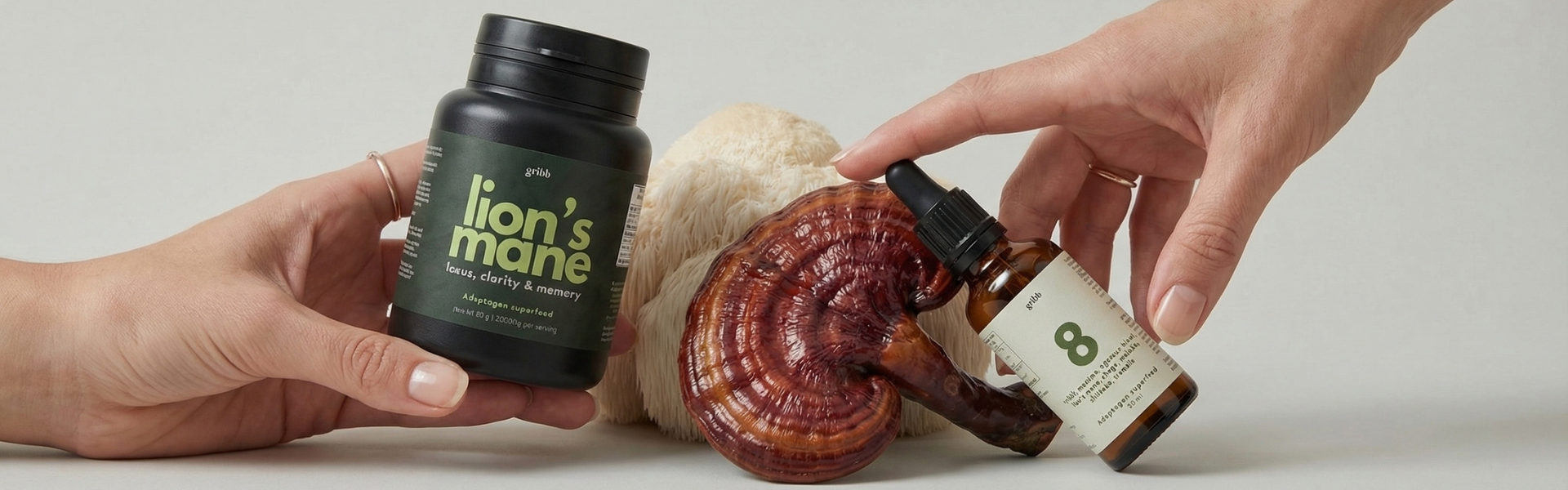
This is precisely where adaptogenic support becomes relevant — not as a magic fix, but as a physiological buffer. Functional mushrooms like Lion's Mane and Reishi aren't stimulants. They don't force an outcome. They support the nervous system's capacity to regulate itself. That's a very different thing, and it matters when you're trying to build something sustainable.
A 2023 randomised controlled trial at Northumbria University found that 28 days of Lion's Mane supplementation was associated with reduced subjective stress scores in healthy young adults. Participants also showed faster cognitive processing speed from a single dose. The researchers noted these were the first findings of this kind in a young, healthy population. (Docherty et al., Nutrients, 2023)
What actually works: the 3-dimension approach
The most resilient wellness rituals tend to operate across three dimensions: calm, energy, and longevity. Not because it's a neat framework, but because that's how the body actually functions — as an integrated system, not a set of isolated problems to solve.
Rather than building a long list of things to do, consider anchoring to one intentional moment per day. A cacao blend with Lion's Mane in the morning. A Reishi tincture in the evening. Not because it's a programme, but because it's a signal you send to your nervous system — I'm doing something for myself today.
The consistency of that signal, repeated over 21–30 days, is what creates lasting change. Not the intensity of it.
When is the right time to start a wellness routine?
Now. Not after the season settles. Not after the busy period. Now, with the tiniest possible version of what you want to build. Spring is a fine season to begin — as long as you're not trying to run a marathon on day one.
One ritual. One moment. One mushroom. That's a real start.
The hustle-health narrative is exhausting and most people in their 20s and 30s know it. The shift toward nervous system support, consistency over intensity, and ritual over routine isn't a trend — it's a correction. Gribb fits here naturally.