



5 Signs Your Nervous System Needs Support (Not a Detox)
Every April, the same thing happens.
Someone says "I need a detox" and means it. They're tired of feeling tired. Foggy, reactive, wired at midnight, flat by 3pm. The solution they reach for is a cleanse, a reset, a 10-day programme that promises to flush out whatever is making them feel this way.
But here's what most detox marketing doesn't tell you.
A lot of those symptoms aren't a toxin problem. They're a nervous system problem. And a juice cleanse won't fix your nervous system.
Support will.
This article is about learning to tell the difference.
What your nervous system actually does
Your nervous system is the command centre of your entire body. It regulates your heart rate, your digestion, your sleep, your stress response, your mood, your ability to focus — all of it.
It operates across two main modes.
The sympathetic state — often called fight or flight — activates when your body senses a threat. Heart rate rises. Digestion slows. Cortisol and adrenaline flood the system. You become alert, reactive, ready to move.
The parasympathetic state — rest and digest — is the recovery mode. Heart rate slows. Digestion resumes. The body repairs, consolidates memory, processes emotion, and prepares for the next day.
The problem most people face isn't that their sympathetic system activates. It's that it never fully switches off.
Modern life — screens, deadlines, news cycles, social pressure, disrupted sleep — keeps many of us in a low-grade activated state almost constantly. The body was not designed for this. And over time, it starts to signal that something needs to change.
Here are five of those signals.
Sign 1: You're tired but you can't switch off
You've been exhausted all day. You finally get into bed. And then — nothing. Your mind is running. Your body is restless. Sleep takes an hour to arrive, or it arrives and doesn't stay.
This is one of the most common signs of a nervous system that is stuck in sympathetic overdrive.
The body hasn't received the signal that it's safe to rest. Cortisol, which should naturally lower in the evening, remains elevated. The parasympathetic state that enables deep sleep can't fully activate.
This isn't insomnia in the clinical sense for most people. It's a dysregulation pattern — a nervous system that hasn't been given the tools to downregulate.
What it isn't: a sign that you need to cut out caffeine entirely, do a 5am cold shower, or take melatonin indefinitely.
What it is: a signal that your nervous system needs consistent, daily support to find its natural rhythm again.
Sign 2: Small things feel disproportionately big
The email that shouldn't bother you does. The comment in a meeting sits with you for hours. A minor inconvenience — a delayed train, a changed plan — produces a reaction that feels bigger than the situation warrants.
This is not a personality flaw. It's a nervous system in a state of chronic low-level activation.
When the sympathetic system is running too hot for too long, the threshold for perceived threat drops. Things that would normally pass through are registered as problems. The body is essentially over-prepared — braced for something that isn't coming.
The result is a kind of emotional reactivity that feels out of proportion and often leaves people frustrated with themselves. Which adds another layer of stress. Which keeps the cycle going.
What it isn't: anxiety disorder in every case, or evidence that something is fundamentally wrong with you.
What it is: a signal that your nervous system's stress response is calibrated too high and needs consistent downregulation support.
Sign 3: Your energy crashes at the same time every day
The 3pm wall. The post-lunch collapse. The sudden drop from functional to foggy that hits at roughly the same time each afternoon.
Circadian energy dips are normal. But a crash — where focus dissolves, motivation disappears, and the pull toward sugar or caffeine becomes almost physical — is the nervous system and adrenal system communicating something.
For many people this pattern reflects a cortisol curve that has been disrupted. Cortisol should be highest in the morning, giving you alertness and energy, and should taper through the day. When the nervous system has been under sustained load, this curve flattens or inverts — low cortisol in the morning produces sluggishness, and a compensatory spike in the afternoon produces the crash when it drops.
What it isn't: a reason to add another coffee or power through with willpower.
What it is: a signal that your body's energy regulation system needs support — not more stimulation.
Sign 4: You feel disconnected from your body
This one is harder to name, but many people recognise it when they hear it.
A general sense of being slightly removed from yourself. Not being able to fully relax, even in safe environments. Difficulty feeling pleasure or ease the way you used to. A kind of flatness that isn't quite sadness.
This can be a sign of a nervous system that has been in a protective state for so long that it has partially numbed out. The body's way of managing chronic activation is sometimes to reduce sensitivity — to turn the volume down on everything, including the good things.
It's often described as feeling "meh" in a way that's hard to explain to other people. You're functioning. You're fine. But you're not really there.
What it isn't: depression in every case, or something to push through or suppress.
What it is: a signal that the nervous system needs gentler, consistent support to come back into regulation — and that your relationship with rest and recovery needs attention.
Sign 5: You've forgotten what rested actually feels like
When was the last time you woke up and felt genuinely restored?
Not just not-tired. Actually rested. Clear-headed, present, ready.
If you have to think hard to remember, that matters.
Sleep quantity is not the same as sleep quality. Many people are sleeping seven or eight hours and waking up unrefreshed. The nervous system isn't entering the deeper restorative stages of sleep consistently enough. Recovery is incomplete. And the deficit accumulates.
This is often the sign people dismiss the longest — because they're technically sleeping, so they assume they're fine. But the body keeps score.
What it isn't: something that more sleep alone will fix, in most cases.
What it is: one of the clearest signals that the nervous system needs structured daily support, not just more hours in bed.
So what actually helps?
Not a detox.
Detoxes target the digestive and hepatic systems. They don't directly address the autonomic nervous system, the HPA axis, or the cortisol patterns that underlie most of the signs above.
What the nervous system responds to is consistency. Small, regular inputs that signal safety, support parasympathetic activation, and give the body what it needs to regulate itself over time.
This is where functional mushrooms come in.
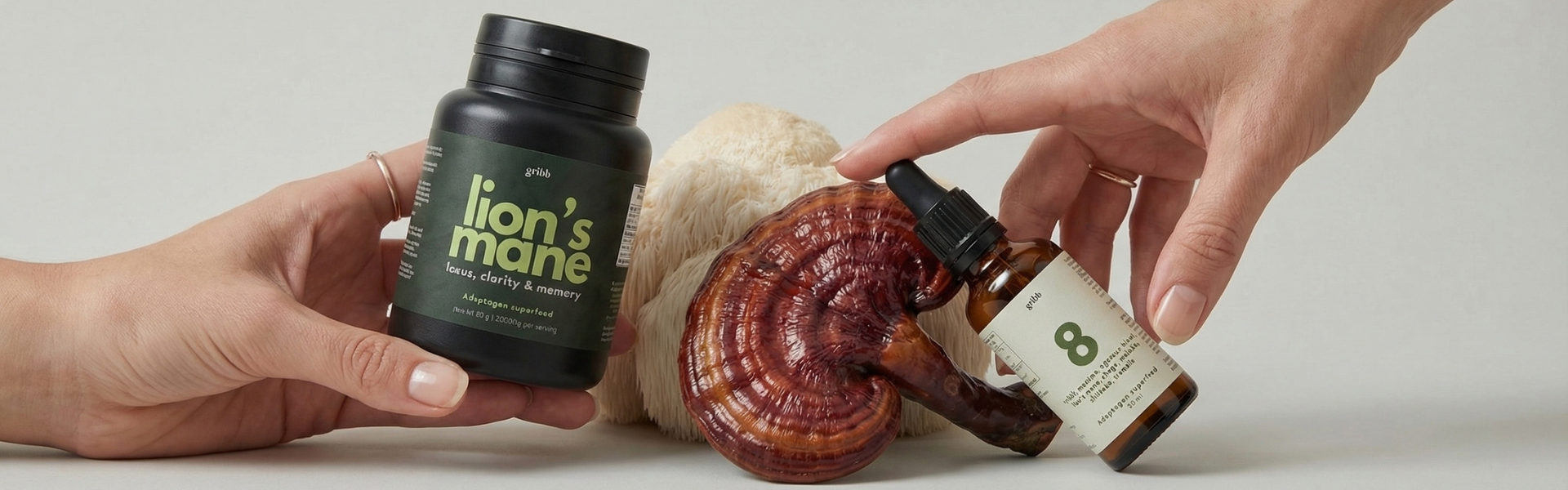
Reishi (Ganoderma lucidum) is one of the most studied functional mushrooms for nervous system support. It contains triterpenes — compounds that interact with the body's stress response pathways and support the kind of calm that isn't sedation. It doesn't switch you off. It helps the off switch work properly.
Used consistently — not occasionally, not in large one-off doses, but as part of a daily ritual — it gives the nervous system something to lean on.
Lion's Mane supports cognitive clarity and focus, which often suffers when the nervous system is dysregulated. Cordyceps supports energy and adrenal function, which is frequently compromised in the pattern described above.
Together, as part of a simple, consistent ritual, they support the system from multiple directions.
Not overnight. Not dramatically. But steadily — which is how the nervous system actually heals.
The honest summary
If you recognise yourself in more than one of the signs above, you are not broken. You are not failing at wellness. You are a person whose nervous system is carrying a lot and hasn't had much help.
The answer isn't a more intense programme. It's a gentler, more consistent one.
Start small. Build a ritual that fits your actual life. Give it thirty days.
That's it.
Not sure where to start? Take the Gribb quiz → Explore Reishi Tincture · Reishi Powder ·
Read more
Why Spring Is the Worst Time to Start a Wellness Routine (And What to Do Instead)
.Everyone tells you to reset in January or bloom in April. Here's why those timelines work against you — and what actually sticks. Let's be honest. Something about spring makes everyone feel like...
Consulte Mais informação
The 3-Product Ritual: Why Less Is More When It Comes to Functional Mushrooms
The supplement industry wants you to take seventeen things. Your nervous system wants you to take three — consistently. Here's the difference that makes. If you've started looking into functiona...
Consulte Mais informação