


Your Sleep Tracker Is Making You a Worse Sleeper. (Orthosomnia Is Real.)
You spent €300 on a ring that was supposed to fix your sleep. Now you lie awake watching it judge you. Your sleep score is 72. You know it's 72 because you checked it before bed. You're thinking about why it's 72. You can't fall asleep because you're thinking about why it's 72.
This is not irony. This is a documented medical condition. Clinicians have named it orthosomnia, and it is now appearing in peer-reviewed literature as a measurable side effect of the wearable wellness industry.
The device designed to improve your sleep is, for a growing number of people, making it significantly worse.
What orthosomnia actually is
The term was first introduced in a 2017 paper in the Journal of Clinical Sleep Medicine by Kelly Baron and colleagues at Rush University. They described patients presenting with complaints about their sleep — who, on clinical evaluation, had perfectly adequate sleep. The cause of their distress: their fitness tracker said otherwise.
The mechanism is straightforward. Sleep trackers use accelerometers and heart rate variability algorithms to estimate sleep stages. These estimates are genuinely imprecise — consumer devices misclassify sleep stages at rates of 30–50% compared to clinical polysomnography. But because the number is on your wrist and in your morning report, it feels like truth. And truth, especially bad truth about your health, activates the sympathetic nervous system.
You check your score. The score is bad. Your cortisol rises slightly. Your threat-detection system logs that something is wrong. You carry that into the next night. Sleep — which requires the parasympathetic nervous system to dominate — becomes harder to initiate. Your score drops again. The loop tightens.
A 2024 review in CHEST Physician confirmed orthosomnia is being observed in clinical sleep practice with increasing frequency. The American Academy of Sleep Medicine has noted that consumer sleep trackers have accuracy limitations that are rarely communicated to users and that the psychological impact of inaccurate negative feedback is an under-recognised clinical problem. A separate 2023 study found that participants who received negative sleep quality feedback — even when fabricated — showed measurable reductions in cognitive performance the following day. The belief that you slept badly is neurologically almost as costly as actually sleeping badly.
The deeper problem: you turned sleep into a performance
Sleep is the one biological process that is actively undermined by trying too hard. The harder you try to sleep, the less you sleep. This is not a metaphor. It's the basis of CBT-I (Cognitive Behavioural Therapy for Insomnia), the only intervention with robust long-term evidence for chronic insomnia.
Wearable sleep culture transformed a passive recovery process into an optimisation challenge. You now have a daily grade. You can fail sleep. And failure — real or measured — is cognitively expensive in exactly the wrong direction.
The Global Wellness Summit named the "Over-Optimisation Backlash" one of its top 10 trends for 2026, noting that relentless self-monitoring is making people psychologically sicker. Sleep is where this plays out most clearly, because the consequences are the most immediate.
What actually regulates sleep (and what doesn't)
Sleep initiation requires one thing above everything else: the autonomic nervous system shifting from sympathetic (alert, active) to parasympathetic (rest, restore) dominance. This shift is mediated primarily by the HPA axis — specifically, the evening drop in cortisol that allows melatonin to rise.
Anything that activates the sympathetic system in the evening delays or prevents this shift. The list includes: stress, blue light, stimulants, news, arguments, and — here it is — reading a health metric that tells you your body is failing.
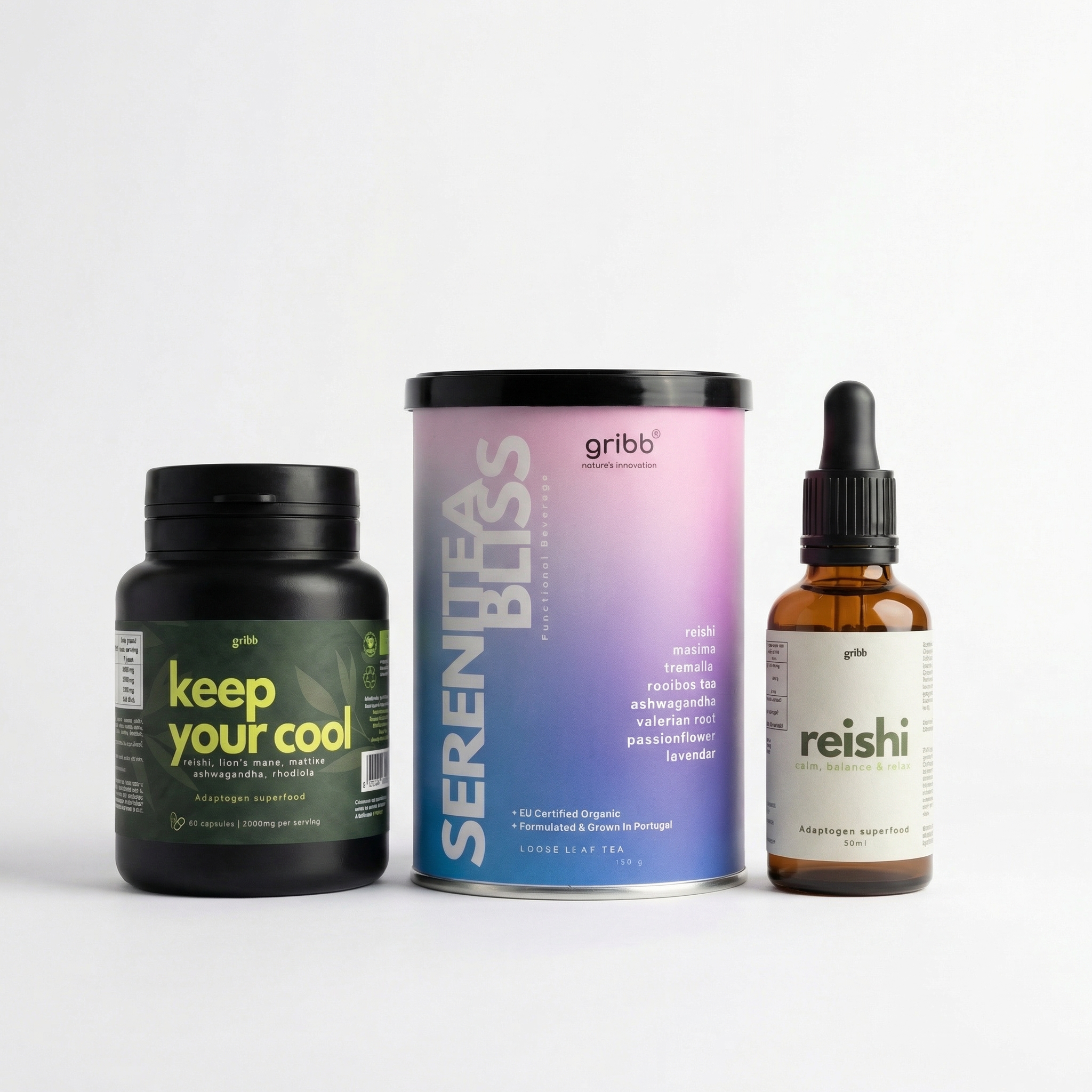
Ganoderma lucidum contains triterpenoids that act on the GABAergic neurotransmitter system — the same pathway targeted by sleep medications, without dependency risk or morning impairment. Reishi also directly modulates the HPA axis: multiple studies show it reduces evening cortisol reactivity and improves the cortisol drop that initiates sleep. A key study in the Journal of Pharmacological Sciences (2012) found that Reishi polysaccharides increased total sleep time and specifically non-REM deep sleep in treated subjects. The compound works upstream — at the regulation layer — rather than forcing sedation.
The practical protocol: what to actually do
Stop checking your score before bed
This sounds obvious. It isn't, because the apps are designed to be checked. Move your sleep data review to mid-morning, after you've had coffee and before any scheduling decisions. Your brain needs to be out of sleep-mode before it can process sleep data neutrally.
Treat the tracker as directional, not diagnostic
A week of low scores matters. One bad score doesn't. Consumer wearables have 30–50% error rates on sleep stage classification. A single night reading is close to noise. If you're making lifestyle decisions based on one night's data, you've built your protocol on a measurement with low signal-to-noise ratio.
Use Reishi as the evening intervention, not the tracker as the morning one
Reishi 60–90 minutes before sleep addresses the actual mechanism. It lowers evening cortisol reactivity, eases the sympathetic-to-parasympathetic transition, and supports deep sleep architecture. This is the intervention with biological roots. The tracker is a recorder. It cannot change what it measures.
The 90-minute rule still applies
Dim lights, no screens, no cortisol-spiking inputs in the 90 minutes before sleep. Not because it's wellness advice. Because cortisol spikes take 30–60 minutes to subside and a spike at 10pm makes 11pm sleep physiologically difficult.
None of this means throwing the tracker away. Used as a weekly trend indicator, wearable data has real value. The problem is the nightly ritual of checking, interpreting, and catastrophising — which activates the exact neurological system that prevents good sleep.
The ring can't fix what the ring is causing.
References
- Baron K.G. et al. (2017). Orthosomnia: Are Some Patients Taking the Quantified Self Too Far? Journal of Clinical Sleep Medicine, 13(2).
- CHEST Physician (2024). Using consumer sleep trackers in clinical practice: benefits, limitations and orthosomnia risk.
- Kaida K. et al. (2023). Negative sleep feedback reduces next-day cognitive performance regardless of actual sleep quality. Sleep Medicine, 107.
- Cui X.Y. et al. (2012). Extract of Ganoderma lucidum prolongs sleep time in rats. Journal of Pharmacological Sciences.
- Tang W. et al. (2005). A randomized double-blind study of Ganoderma lucidum polysaccharides for fatigue and quality of life. Journal of Medicinal Food.
- Global Wellness Summit (2026). The Future of Wellness 2026: The Over-Optimisation Backlash.
- Morin C.M. et al. (2023). Cognitive-behavioural therapy for chronic insomnia. JAMA, 330(3).
Read more

How to Build a Wellness Ritual You Can Actually Keep
Most wellness routines don't fail because you lack discipline. They fail because they were built wrong from the start. You've been here before. You map out your mornings — supplements at 7am, worko...
Read more
Perimenopause Brain Fog Is Real. And It's Not Just Your Hormones
You're in your late 30s or 40s. You can't remember where you put your keys, you lose words mid-sentence, you walk into a room and have no idea why you're there. You feel like you're slowly gettin...
Read more