




Attention Collapse: Why You Can't Focus Anymore (And It's Not You)
You sit down to work.
You know what you need to do. You even want to do it.
And then — nothing.
Your eyes land on the screen and slide off it. You open a tab, forget why, open another. Ten minutes pass and you haven't started. You check your phone. Put it down. Pick it up again.
You tell yourself to focus. You try harder. It doesn't work.
So you tell yourself something is wrong with you. That you're lazy. Undisciplined. Broken in some modern, embarrassing way that everyone else seems to have figured out.
You're not.
What you're experiencing has a name. It has a mechanism. And it has nothing to do with your character.
What attention actually is
Attention isn't a personality trait. It's a biological resource.
Like muscle glycogen or sleep pressure, it depletes with use and restores with recovery. And like those systems, when it's chronically depleted without adequate restoration, it stops functioning at its baseline capacity.
Your brain's ability to sustain directed attention — to hold a single task in focus long enough to actually complete it — is governed by a network of interconnected systems. The prefrontal cortex handles executive function and task prioritisation. The default mode network manages mind-wandering and self-referential thought. The locus coeruleus regulates arousal and alertness through norepinephrine.
When these systems are well-resourced and properly regulated, focus feels effortless. Not easy exactly — but available. You can sit down, begin, and stay with something.
When they're depleted, dysregulated, or constantly interrupted, focus becomes effortful in a way that feels almost physical. Like trying to hold water in your hands.
Most people today are living in the second state. Not because they're failing. Because the environment they're operating in was not designed for sustained human attention.
The attention economy did this
This is not a conspiracy theory. It's a documented design philosophy.
Every major digital platform — social media, news, streaming, messaging — is built around a single metric: time on platform. The longer you stay, the more data they collect, the more advertising they can sell.
To maximise time on platform, these systems are engineered to interrupt. To reward novelty. To make the next piece of content always slightly more stimulating than the last. To make the pause between one thing and the next feel almost physically uncomfortable.
What this does, neurologically, is train your brain's reward circuitry to expect constant novelty and to experience the absence of stimulation — the quiet required for deep work — as a kind of threat.
Dopamine, your brain's primary reward and anticipation signal, gets calibrated to a baseline of constant digital stimulation. Real work — which requires sitting with difficulty, tolerating boredom, delaying gratification — stops feeling rewarding in comparison. Not because the work isn't meaningful. Because the neurochemical baseline has been shifted.
The result is a brain that is simultaneously overstimulated and underperforming. Busy but not productive. Active but not focused.
And the cruel irony is that the harder you try to focus in this state — the more you judge yourself for failing — the more cortisol you produce, which further degrades prefrontal cortex function, which makes focus even harder.
Willpower doesn't fix this. Support does.
What chronic distraction does to the brain
The research here is increasingly clear and increasingly uncomfortable.
A Microsoft study tracking digital attention spans found that the average time before task-switching had dropped significantly over a decade of smartphone use. Separate research from the University of California, Irvine found that after a digital interruption, it takes an average of 23 minutes to return to deep focus on the original task.
Twenty-three minutes. For a single interruption.
Most people working in digital environments experience dozens of interruptions per day. Which means most people are spending the majority of their working hours in a state of perpetual cognitive recovery — never quite reaching the depth of focus where real thinking, real creativity, and real output actually happen.
But the consequences go beyond productivity.
Chronic attentional fragmentation — the constant switching, the inability to stay with one thing — is associated with elevated cortisol, reduced working memory, increased anxiety, and a subjective experience of mental exhaustion that sleep alone doesn't resolve.
The brain, like any system under sustained load without adequate recovery, begins to show the strain.
The neurological gap most people don't know about
Here's the part that gets missed in most conversations about focus.
Attention isn't just about discipline or environment. It's about neural infrastructure.
Your brain's capacity for sustained focus depends on the health and density of the neural connections responsible for that function. These connections — maintained by proteins called Nerve Growth Factor (NGF) and Brain-Derived Neurotrophic Factor (BDNF) — are not static. They grow with use and stimulation. They atrophy with neglect, chronic stress, and poor sleep.
In a brain that is well-rested, well-nourished, and adequately supported, NGF and BDNF levels are sufficient to maintain the neural pathways that focus depends on. The signal gets through.
In a brain under chronic load — stressed, sleep-deprived, digitally overstimulated — NGF and BDNF production is suppressed. The neural infrastructure degrades. The signal gets weaker.
This is why focus problems feel physical. Because in a meaningful neurological sense, they are.
And this is where Lion's Mane enters the conversation.
What Lion's Mane actually does for attention
Lion's Mane (Hericium erinaceus) is the most researched functional mushroom for cognitive function. Its key active compounds — hericenones, found in the fruiting body, and erinacines, found in the mycelium — are among the only naturally occurring substances known to stimulate NGF synthesis in the brain.
What this means practically is that consistent Lion's Mane use supports the maintenance and growth of the neural connections that sustained attention depends on. Not by creating artificial stimulation — not by borrowing from tomorrow the way caffeine does — but by supporting the underlying infrastructure.
A 2023 double-blind, placebo-controlled trial published in Nutrients found that young healthy adults taking Lion's Mane showed significantly improved cognitive processing speed and reduced subjective stress after 28 days. A landmark 2009 study in Phytotherapy Research found meaningful improvements in cognitive function in older adults with mild cognitive impairment after 16 weeks of consistent use.
The mechanism isn't a jolt. It's a rebuild.
Which means it takes time — typically two to four weeks of consistent daily use before most people notice a meaningful shift. But the shift, when it comes, is qualitatively different from caffeine. Less urgency, less anxiety, less of the jittery forced-focus that crashes two hours later.
More like remembering what it felt like when thinking was easy.
What actually supports attention long-term
There is no single fix for attention collapse. Anyone selling you one is lying.
But there is a set of conditions under which the brain's attentional systems can begin to recover — and functional mushroom support is one meaningful part of that picture.
Reduce the interruption load. The 23-minute recovery window is real. Every notification, every tab switch, every phone check resets the clock. Structural changes to your environment — phone in another room, notification blocks, single-tab work sessions — matter more than any supplement.
Protect deep sleep. NGF and BDNF are primarily produced during slow-wave sleep. A brain that isn't completing its overnight restoration is a brain whose neural infrastructure is being gradually depleted. Sleep is not optional for cognitive function. It's the factory floor.
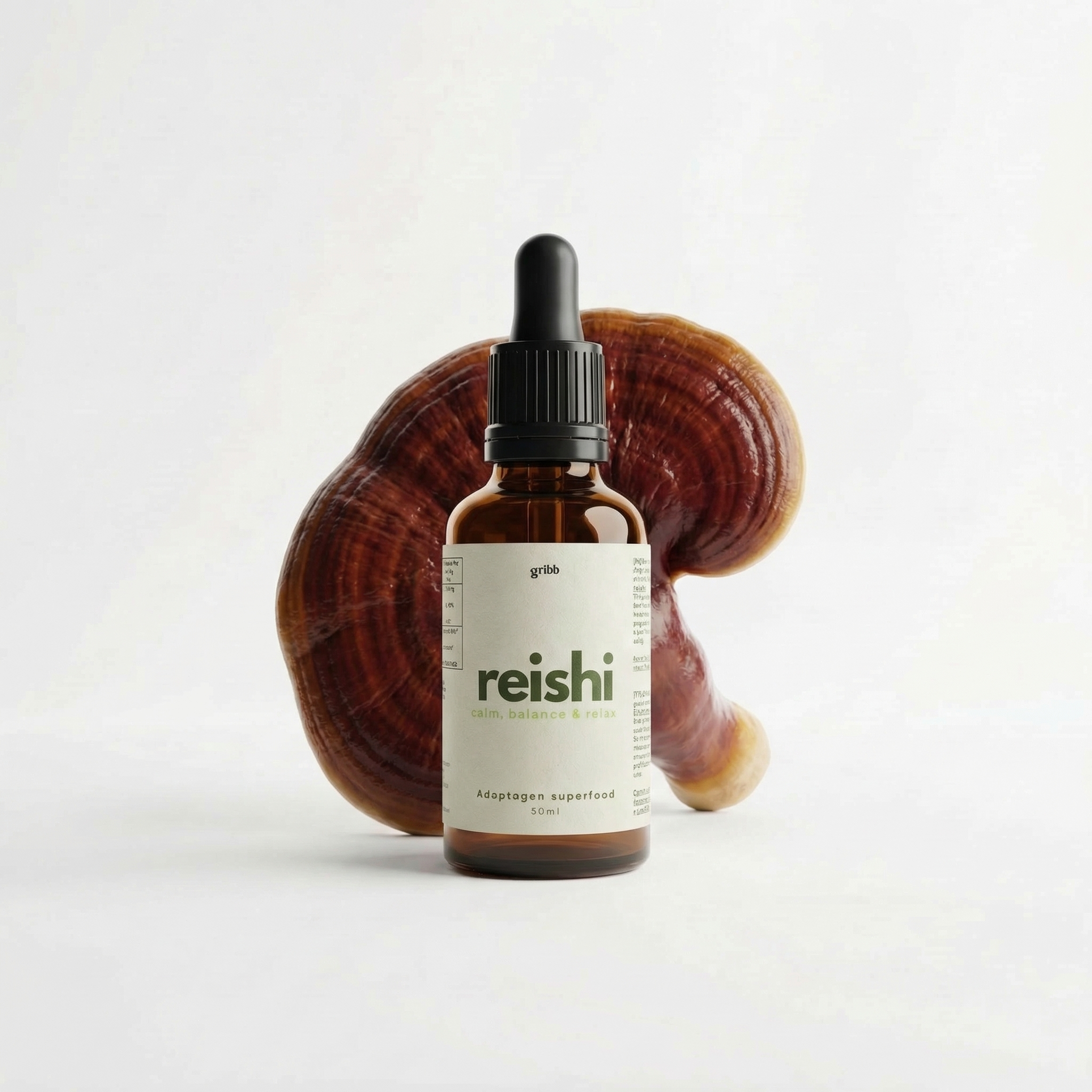
Support the nervous system consistently. A dysregulated nervous system — running hot, cortisol elevated, always slightly activated — cannot sustain deep attention. The calm required for focus is not just psychological. It's physiological. Reishi supports the nervous system's ability to downregulate. Lion's Mane supports the neural infrastructure. Together, as a consistent morning ritual, they address the problem from two directions.
Stop trying harder. This is counterintuitive but important. Effort and self-judgment increase cortisol. Elevated cortisol degrades prefrontal cortex function. The harder you try to focus through will alone, the worse the underlying conditions become. The path back to attention is not intensity. It's consistency, support, and the removal of the conditions that caused the collapse in the first place.
The honest timeline
Two weeks of consistent Lion's Mane use: subtle. Most people notice slightly less friction in the first hour of work. A little less of the sliding-off-the-page feeling.
Four weeks: clearer. The mornings feel more available. Deep work becomes accessible again, not every day, but most days.
Eight weeks: this is where most Gribbers say something shifted. Not a transformation. Just a brain that feels more like theirs again.
That's the honest timeline. Not a miracle. Not overnight. Just a nervous system, properly supported, doing what it was always capable of.
References
- Docherty S, Doughty FL, Smith EF. "The Acute and Chronic Effects of Lion's Mane Mushroom Supplementation on Cognitive Function, Stress and Mood in Young Adults." Nutrients. 2023;15(22):4842.
- Mori K, Inatomi S, Ouchi K, Azumi Y, Tuchida T. "Improving effects of the mushroom Yamabushitake (Hericium erinaceus) on mild cognitive impairment: a double-blind placebo-controlled clinical trial." Phytotherapy Research. 2009;23(3):367–372.
- Ma BJ, Shen JW, Yu HY, Ruan Y, Wu TT, Zhao X. "Hericenones and erinacines: stimulators of nerve growth factor biosynthesis in Hericium erinaceus." Mycology. 2010;1(2):92–98.
- Mark G, Gudith D, Klocke U. "The cost of interrupted work: more speed and stress." Proceedings of the SIGCHI Conference on Human Factors in Computing Systems. 2008:107–110.
- Arnsten AFT. "Stress signalling pathways that impair prefrontal cortex structure and function." Nature Reviews Neuroscience. 2009;10(6):410–422.
- Levitin DJ. The Organised Mind: Thinking Straight in the Age of Information Overload. Dutton, 2014.
- Bhattacharya S, Bhattacharya A, Sairam K, Ghosal S. "Anxiolytic-antidepressant activity of Withania somnifera glycowithanolides: an experimental study." Phytomedicine. 2000;7(6):463–469.
- Walker M. Why We Sleep: Unlocking the Power of Sleep and Dreams. Scribner, 2017.
Ready to support your focus properly?
Energy & Focus






Frequently Asked Questions
Difficulty focusing is rarely a willpower problem. It's most commonly a sign of neural resource depletion — caused by chronic stress, poor sleep, digital overstimulation, or a combination of all three. The harder you try to force focus without addressing the underlying conditions, the more cortisol you produce, which further impairs prefrontal cortex function. Support and structural changes are more effective than effort alone.
Attention collapse refers to the progressive degradation of sustained attentional capacity caused by chronic digital overstimulation, stress, and inadequate neural recovery. It's characterised by an inability to hold focus on a single task, compulsive task-switching, and a subjective sense of mental exhaustion that doesn't resolve with rest alone.
They share significant overlap. Brain fog typically describes a subjective sense of mental cloudiness, slow processing, and difficulty with recall. Attention collapse is more specifically about the inability to sustain directed focus. Both can result from the same underlying causes — nervous system dysregulation, poor sleep, chronic stress, and neural resource depletion — and both respond to similar support strategies.
Lion's Mane contains compounds called hericenones and erinacines that stimulate the production of Nerve Growth Factor — a protein critical for maintaining and developing the neural connections responsible for cognitive function. Research suggests consistent use over 28+ days supports processing speed, working memory, and reduced mental fatigue. It is not a treatment for any medical condition.
Most people notice subtle shifts within two weeks of consistent daily use. More meaningful improvements in sustained focus and cognitive clarity typically emerge between four and eight weeks. The mechanism is cumulative — Lion's Mane supports neural infrastructure over time rather than producing an immediate stimulant effect.
Read more

Why Your Morning Feels Hard (It's Not Laziness)
You open your eyes. And before you've moved, before you've checked your phone, before the day has technically started — something in you is already tense. There's a low hum of pressure. A chest tha...
Read more
Can Burnout Look Like ADHD? The Science Behind Focus Loss and How to Tell the Difference
You lose your train of thought mid-sentence. You open a tab, forget why, close it. You read the same paragraph three times. You've started to wonder if you have ADHD. Maybe you do. But here's what ...
Read more