



Why Your Morning Feels Hard (It's Not Laziness)
You open your eyes.
And before you've moved, before you've checked your phone, before the day has technically started — something in you is already tense.
There's a low hum of pressure. A chest that feels slightly tight. A mind already running through the list.
You reach for your phone. Then for caffeine. Not because you want it, but because without it you genuinely don't feel like a functioning person.
You tell yourself you're just not a morning person. That you need more sleep. That you'd be fine if life weren't so busy.
But here's the thing.
This isn't a personality trait. It's not laziness. It's not a discipline problem.
It's a cortisol curve that isn't working the way it should.
And understanding that changes everything.
What cortisol actually does in the morning
Cortisol has a reputation problem. It gets talked about as the stress hormone — the thing you want less of, the enemy of calm.
But cortisol isn't the problem. Dysregulated cortisol is.
In a healthy, well-regulated nervous system, cortisol follows a predictable daily arc. It sits at its lowest point during deep sleep, allowing the body to rest and repair. Then, in the hour before you wake, it begins to rise — gradually, gently — in what researchers call the cortisol awakening response.
This rise is intentional. It's your body's natural alarm system — mobilising energy, sharpening focus, preparing your brain and muscles for the demands of the day. Done well, it's what makes mornings feel possible. Clear-headed. Ready.
The problem is that for a lot of people, this arc has been disrupted.
What happens when the curve breaks
Chronic stress, poor sleep, sustained nervous system load — all of these interfere with the cortisol awakening response.
Instead of a clean, gradual rise, the curve does one of three things:
It stays elevated overnight. Cortisol never drops to its recovery baseline, so the body never fully rests. You wake exhausted despite eight hours in bed.
It spikes too early. Cortisol surges at 3 or 4am, pulling you into a light, anxious half-sleep for the rest of the night. You wake feeling like you've already been running for hours.
It flatlines. The awakening response fails to fire properly, leaving you foggy, slow, and genuinely unable to feel alert without chemical intervention — usually caffeine — until mid-morning.
In each case, the experience is similar. You wake up already behind. Already activated. Already spending resources your body hasn't had time to rebuild.
And no amount of discipline, motivation, or better alarm settings will fix a broken cortisol curve. The nervous system needs support — consistent, daily, properly timed support.
Why caffeine makes it worse over time
This is the part nobody wants to hear.
Caffeine works by blocking adenosine — the compound that signals tiredness to your brain. It doesn't create energy. It borrows it, by suppressing the signal that tells you you're depleted.
For someone with a healthy, well-regulated nervous system, a morning coffee is a pleasant amplifier of a cortisol curve that's already rising cleanly.
For someone whose cortisol awakening response is already dysregulated, caffeine is a mask. It papers over the exhaustion signal without addressing the underlying pattern. And over time, as the body builds tolerance, the dose required to achieve the same effect increases — while the underlying dysregulation quietly deepens.
This is why so many people feel like they can't function without caffeine. They're not imagining it. But the dependence isn't a caffeine problem. It's a nervous system problem that caffeine is temporarily covering.
What the body actually needs in the morning
Not a two-hour routine. Not an ice bath. Not seventeen supplements.
Two things, consistently, that signal to the nervous system that today begins differently.
Something that supports cortisol regulation.
Reishi (Ganoderma lucidum) contains triterpenes that interact with the HPA axis — the hypothalamic-pituitary-adrenal system that governs cortisol production. Research suggests consistent Reishi use supports a more measured stress response and helps the body complete its overnight recovery more fully. The result isn't sedation — it's a morning that starts from a calmer baseline.
Something that supports neural clarity without the cortisol spike.
Lion's Mane (Hericium erinaceus) supports the production of Nerve Growth Factor and Brain-Derived Neurotrophic Factor — proteins responsible for neural connectivity, processing speed, and cognitive resilience. Unlike caffeine, it doesn't create urgency. It reduces friction. The difference between a morning that feels like wading and one that feels like moving.
Together, in a warm morning drink that takes two minutes to make, these two mushrooms address the actual mechanism behind why mornings feel hard — not the symptom.
What a supported morning actually looks like
Not dramatic. Not Instagram-worthy. Just this:
Ten minutes before you open your laptop or your inbox, you make something warm. Our Morning Sunshine Cacao — with Lion's Mane and a base of real cacao — is what we built for exactly this moment. Grounding. Genuinely good. Something your body starts to associate with the beginning of the day rather than the assault of it.
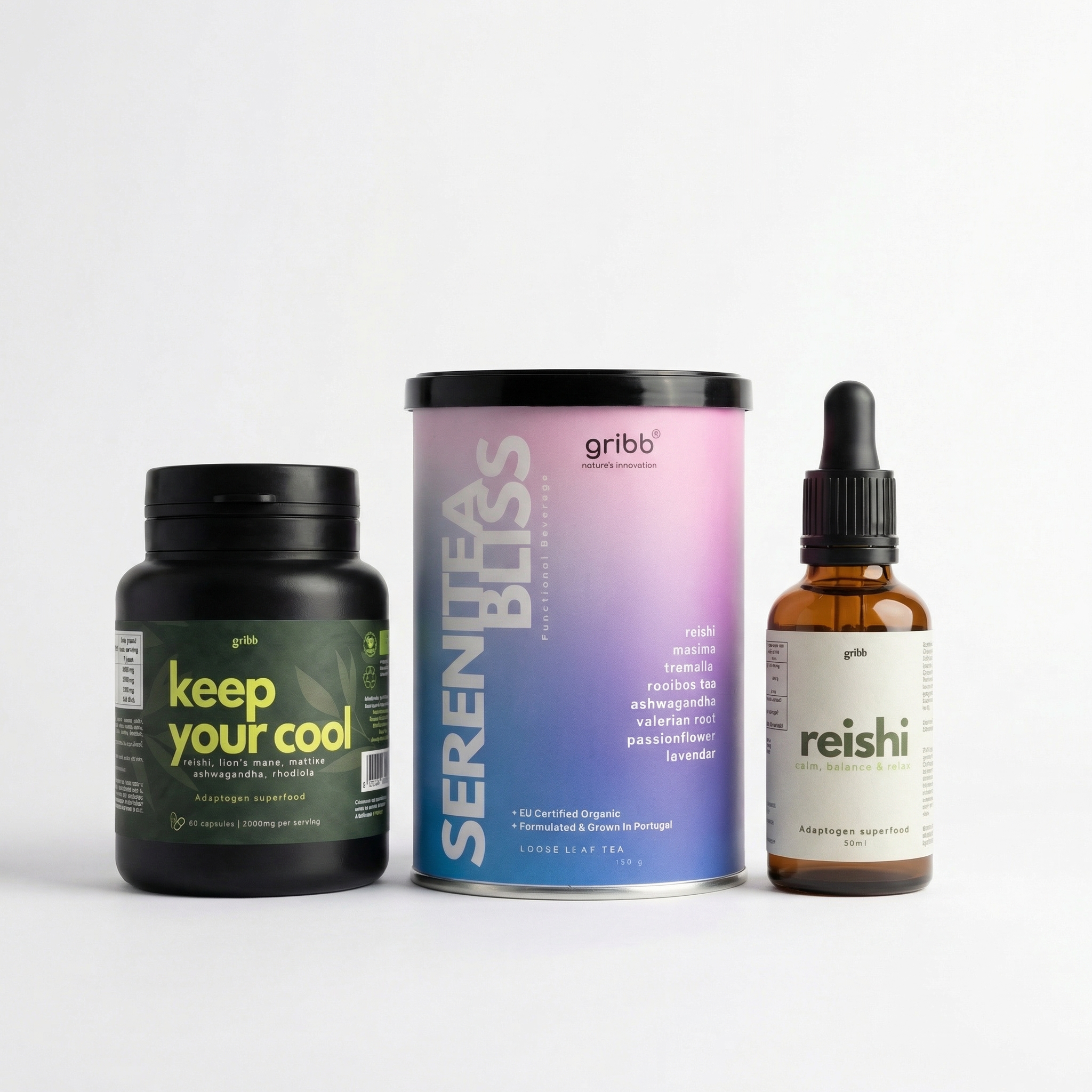
In the evening — and this matters — Reishi tincture. Three drops in water before bed. The support for tonight's cortisol recovery is what determines how tomorrow morning feels. The ritual isn't just morning. It's the close of the day too.
Thirty days of this — not perfectly, just consistently — is when most people notice the shift. Not a transformation. Just mornings that feel a little more like yours.
The honest expectation
Functional mushrooms are not fast. They are not dramatic. They do not fix cortisol dysregulation overnight.
What they do is give your nervous system something to lean on consistently — the way good sleep, movement, and food do. The benefit compounds. And like most things that genuinely work, you tend to notice it most when you stop.
The most common thing Gribbers tell us after a month: "I didn't realise how much easier mornings had gotten until I ran out."
That's how it works. Quietly. Steadily.
Which, it turns out, is exactly how the nervous system heals.
References
- Clow A, Thorn L, Evans P, Hucklebridge F. "The awakening cortisol response: methodological issues and significance." Stress. 2004;7(1):29–37.
- Pruessner JC, Wolf OT, Hellhammer DH, et al. "Free cortisol levels after awakening: a reliable biological marker for the assessment of adrenocortical activity." Life Sciences. 1997;61(26):2539–2549.
- Docherty S, Doughty FL, Smith EF. "The Acute and Chronic Effects of Lion's Mane Mushroom Supplementation on Cognitive Function, Stress and Mood in Young Adults." Nutrients. 2023;15(22):4842.
- Ma BJ, Shen JW, Yu HY, Ruan Y, Wu TT, Zhao X. "Hericenones and erinacines: stimulators of nerve growth factor biosynthesis in Hericium erinaceus." Mycology. 2010;1(2):92–98.
- Cui XY, Cui SY, Zhang J, et al. "Extract of Ganoderma lucidum prolongs sleep time in rats." Pharmacology Biochemistry and Behavior. 2012;101(4):542–547.
- Panossian A, Wikman G. "Effects of adaptogens on the central nervous system and the molecular mechanisms associated with their stress-protective activity." Pharmaceuticals. 2010;3(1):188–224.
- Lovallo WR, Whitsett TL, al'Absi M, Sung BH, Vincent AS, Wilson MF. "Caffeine stimulation of cortisol secretion across the waking hours in relation to caffeine intake levels." Psychosomatic Medicine. 2005;67(5):734–739.
Read more

All you need to know about Reishi
Reishi: The Mushroom That Has Outlasted Empires 2,000 years of tradition. A decade of modern clinical science. One extraordinary fungus — now growing in your corner of the world. 📖 12 min read🔬 ...
Read more
Attention Collapse: Why You Can't Focus Anymore (And It's Not You)
You sit down to work. You know what you need to do. You even want to do it. And then — nothing. Your eyes land on the screen and slide off it. You open a tab, forget why, open another. Ten minutes ...
Read more